Showing posts with label Canaan Christian Community. Show all posts

Friday, July 29, 2011

Haitian parenting, gender roles and the story of dimples

Since noon, a tropical storm has perched its horrible, languid self over Montrouis and buried Canaan in somber grey. It’s the kind of idle day I long for at home. Staying indoors, reading, taking naps. But in Haiti, it’s miserable not being able to get out and explore.

Especially when it’s Friday when work is finished, and the beach is a 15-minute walk down a mountain.

Since beach-destined paperbacks and my iPod’s indie rock genre were re-routed to my bunk bed and absorbed most of today’s boredom shockwaves, I’ll share a few things I’ve been saving up.

Last week, we drove a mother and her 8 mo. old daughter to St. Marc for an X-ray. Tired bodies crushed together in the truck, cramped with our mobile Mamba clinic supplies.

Haitians stuck out their thumbs like hitchhikers or waved at us with both arms as we passed, asking for a ride in the empty truck bed. Younger children jumped in as it bumped along, some naked and careless and not bothering with any gestured formality.

The young mother breastfed her daughter and shielded her baby’s eyes while the truck lurched up and down the mountainside. After working the Mamba clinic for the past two weeks and seeing so many young mothers or female caretakers detached from their children, I was struck by the tenderness of the gesture. Cradling the tiny girl’s head under her breast, clucking softly to the baby, and of course the willingness to cram herself in the truck alongside strangers to drive to a far-off hospital, seemed almost beyond the call of duty for the typical mother.

Affection is often treated like it's impractical.

My first week here, Elsie told me a “good” mother provides enough food for her children to live without starving; that’s all that’s required to meet that guideline. I refused to believe that can be true, at least not entirely.

She told me a story about a young missionary woman who went to the beach and saw a Haitian toddler alone. She played with the child while the parents watched not far away. When it was time for the missionary to leave, the parents emerged and, seeing the young woman absolutely adored the child, put the baby back into her arms and asked her to “keep.” Shocked, the young missionary refused.

However, the next morning, the parents arrived at Canaan with the child dressed neatly in her best clothes, clean and perfumed, to ask the missionary to, please, take their child. For real. To keep. The parents had discussed it seriously all night and decided they wanted to give their baby to the missionary. They did not love the girl, and knew she would be better off with someone who did. Once again, the missionary refused – she couldn’t just put a baby in her carry-on back to the states – but Elsie said it was a lesson in Haitian parenting.

Detachment is a survival mechanism. Show someone else’s baby love, she warned, and they might just try to give their child away.

But there are exceptions for everything.

Single mothers make up the bulk of Haitian family units from my experience in Montrouis. Women of some relation raise the children, commonly older daughters or grandmothers, while the mothers are at the market during the day, bartering and selling. Fathers are absent from the picture, some working their cattle under the banana trees, some in odd-jobs in Port-au-Prince, while the kids grow up.

The women at Canaan hired to take care of the babies at the nursery are my age. Early 20s. No experience with children. Yet they’re living like many Haitian women that age— 24/7 single moms.

It’s been rare from my experience so far, but there are some fathers actively raising and loving on their children. For example, every week, this adorable Haitian dad proudly totes his all-pink bundle of a 5 mo. old girl. The baby’s mother died shortly after giving birth of infection. Malnourished and sick, she was enrolled in the milk program at CESANOJE – open to infants under 6 months who do not qualify for the peanut-butter based Mamba. This dad, however, took all responsibility of child rearing. The baby’s finally alert and putting some chub on her little cheeks, only months ago hollowed with starvation.

Most of the “orphaned” children at Canaan are actually just motherless. Many have fathers or older siblings that live in Montrouis and the surrounding towns. But without a mother, the family unit crumbles. Just this week, a father asked us to take his little boy and presented us with his mother’s death certificate.

Dead mothers make orphans. Dead fathers make hungrier bellies.

Working at Canaan, I’ve noticed distinct gender roles. The men are laborers, in charge of maintenance and construction around the orphanage, clinic and school. The women do the cooking, the cleaning, and all the laundry. None of the men here do their own laundry, not even the boys in the orphanage – the girls inherit that chore. Ironically, the women at Canaan hold the powerful leadership positions when it comes to leading incoming missionary groups and negotiating donations with non-profit relief agencies.

Even the clothes here are gendered. Men wear pants and jeans, while women wear dresses and skirts paired with Ts and the occasional tank top. Some of the bolder 20-somethings wear tight Capri pants. I’ve never see shorts, except on hairy white legs of missionary men and on young girls chasing through slums of Port-au-Prince’s.

Just yesterday, Doctor Jean Robert and I were sipping our black coffee after breakfast, when we received a call. Without a goodbye, he shoved his dirty dishes in my direction and walked off, leaving me fuming. Was he handing me his dirty dishes because I was a woman? Everyone took care of their own dishes and did their own washing, and I pointed this out to the doctor later that day. He seemed unruffled, and I decided to resign myself to cultural norms. If I didn’t pick up his dirty dishes, one of the overworked Haitian women would have to do it.

Doesn’t make it any easier to swallow without resentment.

The gender distinction is particularly interesting when Caroline and I are on Mamba duties. Two white woman driving through town to pick up food is met by laughing men, partly in surprise and more in rude amusement, following us in a herd as we load up the 50 lb sacks of white Texas rice and pinto beans. Women, in our festive skirts and poker faces, carrying our heavy loads to the truck bed while they shake their heads and grin as if to tell us, this ain’t no women’s work.

Cute Haitian Folklore: The Origin of Dimples

The Haitian doctor working at CESANOJE (nickname for Canaan’s community clinic, Center de Santé Nouvelle Jerusalem), shared with me some cute folklore: The story of dimples.

When Haitians talk about dimples, they also point to their lower backs, where the spine curves into the buttocks.

To get dimples, a mother has to push her fingers hard into her baby’s cheeks and lower back during those formative days. Then, voila! Dimples. If someone doesn’t have dimples, their mother either didn’t take an active role in the dimple making, or push hard enough.

Every time I see a Haitian with dimples, I can’t help but smile and imagine a mother’s fingers prodding the cheerful indentions.

Wednesday, July 27, 2011

Mango guts, melon cores and chunky Mamba thighs


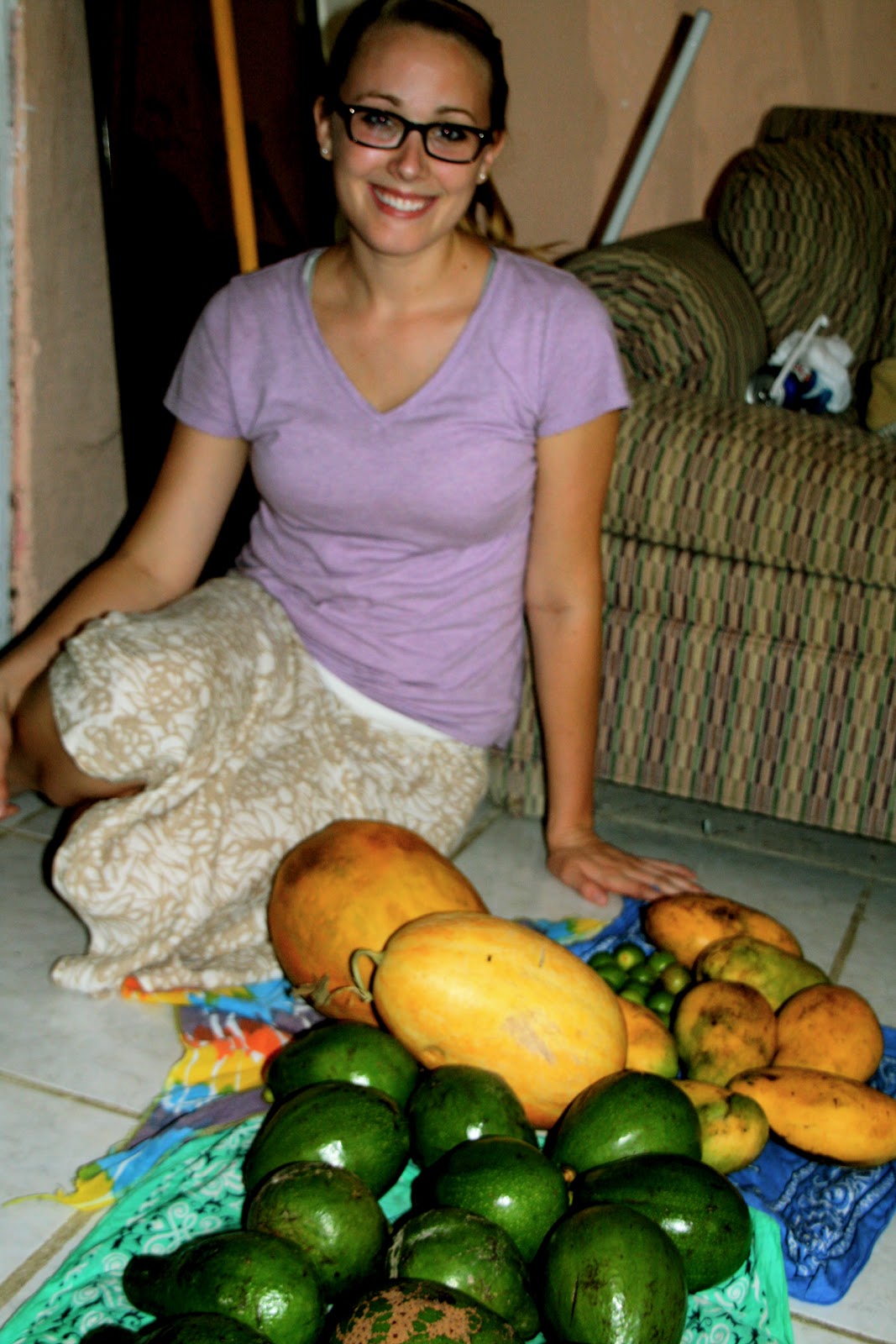
Posing with the fruit purchases... so happy!
Mangos smell rich and womanly under their soft yellow skins, sweet and steamy and damp like fresh mountain rain. Their perfume mesmerized me as I zigzagged through Montrouis’ open market, skirts swishing as women bargained and young boys begged, their hands held open like empty prayers.

After dulling my palate with two weeks of rice, pasta and white bread, the flavor almost choked me. There’s something embarrassingly sensual about biting into a mango, tearing the skin with your teeth. Juices dripped down my chin, and I felt like a child. Or a vampire, sucking zealously on raw flesh.

The texture of a mango is similar to a fine pâté once you get past the stringy bits near the skin. The hard core is a palm-sized heart, emerging from the goopy fruit almost alive, like the trembling meat in an oyster shell. I saw children sucking on the mango hearts like lollypops, leaving the cores smooth and brown.

I had never peeled a mango before, and some of the younger Canaan girls laughed as my fingers clumsily stripped the fruit to keep the precious orange heartstrings intact. The 12-year-old, Marceline, took the mango from me and stripped it meticulously with a knife, peeling it like a sweet potato. Under the swaying tungsten kitchen lights, the naked mango looked and felt like a slimy fist of raw chicken.
Our purchases from the market, minus a couple of mangos we couldn't wait to devour.

Caroline, the full-time director of the Medika Mamba malnutrition program in Montrouis arrived back at Canaan this week from a month-long hiatus. She picked up Creole after only four months mission work thanks to her background in French. I would have been lost without her navigation through the Montrouis fruit venders.

The key, Caroline said, was to play the vendors against one another and let them compete for business. We drove the Mamba truck to the middle of Montrouis to exchange USD for goudes. A bare-chested Haitian man lazily flicked at flies as he did the transaction: 800 goudes for $20 (40 goudes for every dollar).

The market starts on the curb of the winding highway of down-town Montrouis and extends a hair's length from honking tap taps or gestures of high-speed passers-by, filling the market with a stench of diesel. Haiti's Rte 1 cuts through the market's bustle, while a tangle of merchants with massive bowls or cracked tupperware aggressively wander like auctioneers. The more relaxed of the vendors sit under lopsided shelters, displaying everything from glass-bottled beverages to raw meat dizzy with flies.

As soon as we had money, women with huge bowls of melons, avocados, limes, mangos and spiky green and brown fruits I’ve never seen before swamped us. Unable to negotiate in the chaos, with fruits thrust under our noses and rubbed against our skin amid yells of “bon bagay!” (meaning, “good thing!” in Creole), we climbed in the truck and rolled down one of the windows. Caroline bargained ruthlessly, chastising the women as they advertised their wares at twice the street value to us blancs.

When we finally agreed on a fair price, the rapidly truck filled with fruit:

For $5 (US), we bought 13 plump, healthy avocados, picked that morning just miles down the road.

For $1, a handful of fragrant limes. For $2.50 a piece, two swollen and aromatic melons.

For $5, a bucket of mangos, warm from the afternoon sun, that made us drunk and salivating from sweetness.

Total price: $16 US, and we watched as two of the women strutted back home, finally selling all their goods after a long day at the market.

Caroline, Amy, Robin and I devoured the fruit, speaking only with “mmm”s and “ahhh”s.

The avocados need a few days to ripen, but with some garlic, lime juice, salt and pepper, we plan to make guacamole to eat on chips that a missionary team is bringing for us Saturday, per Caroline’s request. We prepared a fruit salad with the mangos and melon, juices marrying in a ceramic mixing bowl and nestled in one of Canaan’s industrial-sized refrigerators. I hope we can stretch it out over all our meals tomorrow, but we put such a dent in the mangos we might be back at market tomorrow.

Today was incredibly fulfilling, in addition to belly-filling. Canaan operates on routine, and I’ve fallen into the predictable cadence as I start my third week in Haiti. Wednesday means Medika Mamba at Rousseau, the rural hospital in the mountains. 

We had quite a few babies graduate from the peanut-butter based malnutrition program today at Rousseau, and Montrouis Tuesday. I love seeing emaciated babies transformed into giggling bundles of meaty arms and chunky thighs. We document these transformations with photographs, and the difference is astounding.

Graduation from the Medika Mamba program is the difference between shriveled, stunted bodies and those healthy rolls that make me smile. It’s death conquered by vitamins, protein and crucial calories.
Women and babies line up for Mamba assessments at Rousseau Hospital.
Twins get undressed to be weighed and examined.
I am exhausted, though. Caroline led us on a 2-hour hike into the mountains. My sweat glands were on overdrive as we climbed the steep rocky path. Like most afternoons, the air felt smarmy and damp and made my glasses slip incessantly down my nose. Out of nowhere, the mountains in the northeast echoed with thunder, and my sweat mingled with dense raindrops.

It’s so peaceful here, watching lightning blaze in the mountains while the coast is serene, untouched blue.

Monday, July 25, 2011

Haitian bourgeoise and fast food cravings


I lived one night like a Haitian bourgeoisie. It was an interesting opportunity to experience Haiti’s frightening rift between the rich and poor.

It’s the difference between mud and mansions.

We drove into Port-au-Prince Saturday night with Sister Glady to her deceased mother’s home, up in the mountains overlooking a portion of the earthquake-desecrated residential areas.

As we passed through Port, every wall and building is splashed with ugly political graffiti from the recent election, bearing candidates’ names and ballot numbers. The rich residential area was also violated by spray paint, but all the ugly melted away as we pulled the truck behind barbed yellow gates.

The house was gargantuan and stately, two-stories surrounded by curling flowers and bushes. It had elegant windows covered in ornate metalwork, scrolling hearts and crosses painted a lovely shade of yellow.

The stairs and floor was covered in colorful glazed stone with the same smooth texture as bathroom tiles. Every room (the rooms seemed endless, with multiple bedrooms and bathrooms and parlors) was decorated in Haitian paintings, hammered metal artwork, and tight woven baskets and vases. The furniture was inviting and cozy under the towering ceiling.

Two of Sister Gladys’ brothers were fixing up the house and were there to greet us. They have been adding bunk beds and accommodations for large missionary groups that come to Port-au-Prince to do relief work and construction.

Like most Haitian households, the windows were carefully positioned around the house to maximize ventilation and airflow. There was a constant breeze that chilled the house in the absence of AC. I love how careful construction can eliminate the need for AC and conserve a ton of energy, especially in a place with notoriously hot weather.

Sunday transformed the city. Port-au-Prince was tamed to easy traffic, well-dressed churchgoers, and crows strolling lazily to the market. There was less honking, less chaos, and a colorful city at ease. Besides a man jumping in the bed of our truck and attempting to steal Katie’s suitcase (VERY unsuccessfully… we had that sucker bound right under a tarp!), the drive was much more peaceful than my past ventures.

We dropped Katie and decided to take advantage of the vacant streets and tour Port-au-Prince by truck. We passed the rubble of downtown, and Sister Gladys pointed out a collapsed third story of a school, where more than 300 children perished to falling cement and earthquake tremors. We drove by the presidential palace, still in ruins and surrounded by matchbox-shaped tents and shacks where the most beautiful park in Port used to flourish.

I remembered a conversation I had with Sister Gladys’ brother, Jean, who was born and met his wife in Port. His wife came back to Haiti after spending 40 years in the U.S., and cried as she walked the streets of her childhood. Cherished memories were replaced by pain and ugliness.

I visualized her tears mingling with the trash and filth of tent city and wished they were enough to make it go away, to heal this broken community.

The English church, Port-au-Prince Fellowship, was a solid reminder that faith can bridge cultural differences. For every foreign missionary, there was a Haitian dancing, clapping and joining in the worship. The band was led by an American man playing guitar, but backed up by an all-Haitian band: 4 women on vocals, a man on keyboard, a man on drums, a woman on saxophone.

I felt at home. The sound of English swelling out the open windows to mingle with the Creole voices at the Haitian churches in service next door made me feel united. I was reminded that Christians bridge the gap between Haiti and home, in this culture different in so many ways from my own.

We ate Haitian fast food after church and met up with Shirley and Alex, a young couple and friends of Sister Gladys who opened a young boys’ orphanage in Port-au-Prince last year. The sandwich, French fries and vanilla cupcake was delicious, but loaded with Mayonnaise and other condiments. Epi d’Or is an extremely popular fast food joint in Port, and offers everything from bacon cheeseburgers and ice cream to traditional Haitian food and cakes. Like the grocery store we visited in Port, the building was huge, packed with people of all nationalities and walks of life, and guarded heavily by security officials carrying impressive guns.

But I’m back to reality now, listening to someone’s donkey braying and the soft whack of a machete in the garden.

I’ll be up late tonight typing a clinic report for the organization overhaul I hope to finish soon. It’s looking fantastic, and we have a huge donation of surplus supplies, including Lactated Ringer’s for cholera, for the hospital in Petit Gôave. Montrouis is not well equipped by any means, but it’s great to see medical supplies pooled where they’re most needed.

Tonight, I have had education on my mind. For a Haitian family to put their child in kindergarten, the cost is around 1500 Haitian dollars a month – a sum out of reach for most families. Education is not free here like it is in the U.S. Many of the schools are pumping money directly into the pockets of corrupt government leaders. Without education, these kids will not be equipped to move Haiti forward. Please pray with me for available primary education and an end to government corruption.

Thursday, July 21, 2011

Haitian hospitals, Medicine food and Creole lessons

Child with Kwashiorkor symptoms.
It has been a week and a day since I arrived in Haiti, but it feels like longer. There was a funeral at Canaan for a man of Montrouis, and I have part of the tune stuck in my head. It reminded me of a New Orleans jazz funeral –- several trumpets and a trombone player played a lively waltz rather than a somber melody. It was a colorful affair, which I peeked at through the steel-barred clinic windows.

I had my first Creole lesson today! Pastor Joelle’s wife taught us the Creole Alfabét, which is almost exactly the same as French, and some basic classroom vocabulary for the women working as English teachers.

Here are a few works of the day that will be useful for the clinic, especially when directing patients to their place while taking vitals:
Chita (la) = sit (here)
(Pa) kanpé la  = (don’t) stand here
Sòti  = go out
Rantré/ antré = come in
My morning was rather monotonous. Katie and I resumed cleaning the clinic storage room and sorting supplies that we think need to be donated to the local hospitals. I’ll be typing the list for Sister Gladys this weekend.

We had to put a lot of supplies in a trash pile for being either trampled in the chaos, covered in dust or bug bits, and some once-sterile containers chewed through by rats. It was also frustrating to see so many surgical supplies YEARS past the expiration date, thrown messily in rotting boxes. It’s fantastic that American medical supply companies are donating to Haiti, but medicines and wound prep kits “good until 2001” aren’t ideal.
View of the mountains through the Mamba truck window, on our way to Rousseau Hospital.

We sang along to Adele from my iPod Touch until our feet were gray from shuffling around in dust.

Here’s my reflection of the day: Why in the world would a rural primary care clinic need Foley catheters, sterile bone saws with leg amputation bags and around 1,000 surgical gowns? It may be a dream down the road to offer care in emergency situations, but for now Canaan doesn’t have the resources (or the space!) to store these supplies. They need to go where there’s a pressing need or them, like the hospitals in Pierre Payan, St. Marc and Rousseau, with specialty doctors on staff to address these needs. Otherwise they’ll end up like the pile we trashed—dirty, rat-eaten and unusable.

Yesterday I woke up with nausea and abdominal pain. I had to sit with my head between my knees so I wouldn’t start dry heaving at breakfast. The change in diet has disrupted my digestion, but who knows exactly what set it off. However, it was a busy day and I had no time to take it easy.

Doctor Jean Robert prescribed me some medication that the pharmacist, Henry, only gave me after teasing me in drawling French. Katie and I, along with Mis Elise and a translator from Canaan, hurriedly loaded the Mamba truck and drove 45 min to Rousseau, a hospital and health center deeper into the mountains than Montrouis.

It was the bumpiest drive I’ve ever been on. We passed a thick river, with naked children washing laundry and stretching linens to dry over skull-white stones. With their thumbs out like hitchhikers, people from Montrouis hailed us to stop so they could jump in the bed and catch a ride along the steep road.

The hospital was nice, but crammed with people waiting for consultations. We set up the Mamba supplies as mothers and grandmothers lined up on a crooked bench. Some of the children were so malnourished that their ages were indiscernible. A mother brought her 5-year-old son, smaller than the 2-year-old I babysit back home. He weighed a shocking 11 kg. An 8-year-old girl weighed only 14 kg, but could not be admitted into the Mamba program because of her age. The nurse gave her bags of rice. We also gave every family we saw to large bags of dehydrated soup – aid for parents as shriveled as their sick babies.

Here, food is medicine.

Rousseau Hospital. My camera was fogging up all day.
We admitted a new baby into the program that had severe edema (swelling) of his legs and belly. The edema is a symptom of Kwashiorkor, a form of malnutrition when the diet doesn't provide enough protein. He looked like a cartoon, his skin suctioned to his rib cage, while his legs and belly swelled like balloons. He was burning up with fever, but we were out of antibiotics. It was horrible feeling to let him leave without proper medication. 

We finished the Rousseau Mamba consultations at noon. After a quick lunch at Canaan, Katie and I drove one of the young mothers and her sick 6 mo. old baby to the hospital in St. Marc for a chest X-ray. A doctor living in the states who serves Canaan in his spare time agreed to take on the baby as a patient. She has strange dimples in her chest, as if her rib cage has been pushed too far back. There’s strangeness in the way it juts, and the baby sounds like she has pneumonia or some kind of lung infection.We didn't have to wait too long for the X-ray, and there were no lead coats for protection. I stepped outside to put a cement wall between my body and the radiation.

I saw my first Emergency Room in Haiti at the St. Marc hospital. It was a large room, smaller than a waiting room from one of the hospitals I work at in Baton Rouge. Mismatched beds were squeezed together like an infirmary. The room was hot and still, except for a single ceiling fan. I can't imagine laying in that stagnant heat for treatment.

I was exhausted and still felt sick after the long day. After dinner, I fell immediately asleep and did not wake up until 6 am this morning: 11 hours, through the generator being turned on and off, without moving. I’m feeling better, but the pain comes and goes.

Wednesday, July 13, 2011

Safe in Beautiful Montrouis

Lam veritab, the Haitian "bread fruit" we ate for
dinner tonight. Photo cred: http://www.haitiworld.net/index.php
I've arrived in Haiti. I'm safe, full of a delicious dinner and settling in the female staff house. Some of the kids who live at the orphanage have been following me shyly around, chanting my name mischievously. I can't wait to learn all their names, especially the spunky preteen who greeted me with a gut-squashing hug.

The flight from Miami to Port-au-Prince was full of expansive skies and layers of aqua, turquoise and lagoon blue waters. I've never seen so much depth to ocean. The Louisiana bayou has its particular muddy charm, but driving to Montrouis along the coast was like skirting trembling sapphire.

This is a beautiful country.

At Toussaint Louverture International Airport, I was one of the first passengers through customs because I had no checked baggage. I had to leave behind the toaster oven I brought for one of the nurses of Canaan at the airport lost and found because, to my surprise, the US has an embargo on any boxes to Haiti until mid-August. It was disappointing to leave behind the brand new appliance and frustrating, too -- especially because I was delayed 30 minutes simply searching for an official to help me find a place to leave the oven without causing a safety scare!

I boarded my flight to Miami at the last call and as the gates were closing. I was frantic and sweaty when I squeezed into my window seat. After a calming hour layover, I flew to Port-au-Prince next to a chatty Haitian student named Whitney. She's also a 21-year-old studying to pursue a career in medicine.

Whitney gave me an airborne "tour" as we flew over the wounded city -- fleets of white and tarp-blue tents, rusted tin roofs and thick, clay colored rivers. She sounded distant as she recalled how the landscape shifted since the earthquake, almost like she has been estranged from a close friend. She shook her head as we passed the neighborhoods still in ruins, but sighed whenever the gorgeous water framed the turmoil. The wing of the plane seemed to trace the edges of tumbling mountains, draping the landscape in patchy brown and green as we descended.

The driver was late to get the the airport, and I had no problems waiting in the shade until a large Haitian man grabbed me and tried to bring me "to my ride." I asked him who he was with, and he said "for your organization." He obviously was not with Canaan. When I refused, he walked alongside me and demanded a tip until, exasperated, he finally moved on to harassing another passenger.

A very kind British relief worker saw me awkwardly shuffling at the exit of the airport and offered to call Canaan for me. She spoke quick, succinct Creole with one of the staff members find out when my driver was coming. This allowed me to relax and calmly refuse the several taxi drivers who approached me, speaking a melodious jumble of French, English and Creole.

When my ride arrived, I learned quickly why they were late. Traffic in Haiti is unpredictable, and it seemed like there were no rules to the road. Drivers on tap-taps (little trucks with an overhang and benches that serve as crowded taxis) peeled out without warning. Large UN vans barreled treacherously between men on scooters and bicycles. The roads from Port-au-Prince were were rocky and jarring and I was dripping with sweat in the back of Canaan's truck (no AC, no rolled-down windows) for the two-hour drive to Montrouis. I fell asleep for a leg of the trip and woke up with a pool of sweat at the small of my back. Hello, equator!

We had a delicious dinner of Lam veritab, known as "bread fruit," baked with SPAM into a potato-like textured pie, as well as pasta with raisins and green beans. Although my stomach has been upset today from the anxiety of traveling, dinner was fantastic and soothing.

The generators were turned on around 6 as it started to get dark. I'm grateful for Internet access and the opportunity to let my friends and family know I'm happy and safe! I'm getting my mosquito net and bunk set up. Here are some pictures of my cozy setup.

The top bunk gets the most breeze, and away from the rats and critters!

My cozy bunk in the female staff house.


It's been thundering all evening and sprinkling on and off, but I'm enjoying the damp, salty humidity. It's finally hitting me I'm here: this is my home for the next 5 weeks. The rough-looking mutts littering Canaan have started howling, and I'm missing my little German shepherd puppy, Vivienne.

No pictures of Montrouis yet, although there have been so many times today my heart has ached for the camera I shoved, without batteries or a working memory card, in my carry-on. Woops. Those will come soon, though!

Thanks for your prayers! I'm praying for a beneficial transition into life here at Canaan, and hoping I can be used here at the community clinic in wonderful ways.

Bonwi, my friends.

Thursday, July 7, 2011

Packing Light: Long-term medical mission work in Haiti

Backpacking at Mont St. Michel in France.
Everything I brought to Europe for the
winter in 2010 fit in my Osprey pack.
Six days left until I'm on a plane to Haiti. Fundraising put me at exactly where I needed to be -- $3,000! St. Paul Lutheran Church donated the last $1,000 leg needed to cover trip costs. I'm elated and ready to work.

I have almost finished packing. I decided early on not to check any bags with plane changes/ long layovers. I spent last winter in France and Hungary with about 15 lbs in my backpack, including food, heavy wool coat, sturdy leather boots, travel books and lots of layers. It saved a ton of money when I flew on the budget airlines (RyanAir and EasyJet), which all charge for checked bags.

My Osprey Aura 50 backpack is just under 3,000 cubic inches, but cinches down to fit into a small overhead compartment. It's much lighter than my old Osprey pack, which was great for long treks in my Girl Scouting days but not ideal for light traveling.

In Haiti, the average summer temperature ranges from 77 to 95 degrees, so I'm going to need less layers and lighter fabrics. My old apartment did not have reliable air conditioning, but I've been spoiled by central air after weeks of house sitting... It's time to get used to the heat again!

Since Canaan requires modest female clothing (no shorts), I found some breezy cotton summer skirts at Goodwill for less than $7 a piece. Everything fits in my pack with plenty of room left over--I'm shooting for less weight than my trip to Europe. However, the extra weight of bed linens is pushing me past my desired pack weight.

I was originally only going to bring 2 outfits to alternate, but I've since changed my mind. I'm not sure how easy it will be to do laundry. I want to be respectful of the locals and dress neatly. Hygiene is a priority for Haitians (and myself), so I am packing heavier than I would for 5 weeks in Colorado back-country. Plus, I plan to leave the majority of my clothes as donations to Canaan.

Here's my packing list for 5 weeks in Montrouis, Haiti (July-August). 
Note: This list works for longer trips as well. 

Clothes/Linens:
4 long cotton skirts from Goodwill (nicer one for church/ traveling)
6 cotton t-shirts
2 white undershirts
1 pair Patagonia baggie shorts for the beach
1 tank-top for weekend lounging
1 pair comfy socks
PJs (yoga pants and a comfy shirt)
Undergarments (undies/bra)
Bathing suit
Bandana & hair stuff
Microfiber camp towel
Twin sheets (& my tiny pillow splurge)
Keen closed-toe Whisper Sandals
Chacos

Toiletries:
Toothpaste/ Toothbrush
All-natural toothpaste
Hand sanitizer
Baking Soda Deodorant (baking soda also relieves itching)
Sunscreen
Aloe Vera Oil (for burns, bug bites & dry skin)
Small Mosquito Repellant with Deet & a larger all-natural bug repellant to dilute
Doxycycline/ antibiotics (An anti-Malaria Rx)
Misc. First Aid items (Neosporin, Benadryl, headache medicine & probiotic digestive aids)

Other:
Passport
List of important phone numbers, copy of passport
Mosquito net
Laptop
Canon Rebel camera
Small battery-operated fan
Laundry Line
2 Water bottles
Headlamp
Ear plugs
Book
Bible
Journal & pen
iPod
Cords/ chargers/ batteries for gadgets

Traveling with contact lenses is a hassle, so I'm just going to stick to wearing my glasses the entire trip. I can bring my case/ back up pair and not have to worry about contact lens case, disinfectant & cleaning fluid, eye drops because contacts irritate my eyes, and replacement lenses. That's another pound or two of gear! The only downside is that I'll have to ditch my non-prescription sunglasses from my pack and rely on sunscreen and a bandana/hat for sun protection

It seems like a lot of stuff listed out, but the little items pack into a very small space. Everything fits in my backpack! Here's a slideshow of the items I'm bringing. The picture with my toiletries was deleted on accident, so another will be posted soon! Enjoy.


Thanks for checking out my blog, for your support and for helping my fundraising efforts be such a success! Please feel free to offer your packing advice and any tips for how I can pare down more!

Love.

UPDATE: One of the wonderful nurses at Canaan has asked me to bring a toaster oven to her new home in Montrouis. (It costs around $39 new at Walmart versus $100 in Haiti with shipping.) Since my backpack is my carry-on, I can take toaster oven as my one free checked bag. Perfect! Light packing pays off.

Sunday, April 3, 2011

Missionary Account: Making Tax Deductible Donations to Canaan Christian Community

Canaan Christian Community is a charitable organization (IRS 501 c3) which means your donations are tax deductible.

To cover all my lodging, food, and any other expenses living at Canaan in Montrouis this summer, I need to raise $15.00 per day. I will be in Haiti for 37 days, which is $555.00. Canaan can start a "missionary account," which allows donations to be made out to Canaan, but used in my name to go strictly towards my living expenses.

On the downside, this amount does not cover the majority of my costs. In fact, I still have money to raise separate from Canaan to cover the cost of travel to Haiti and other trip expenses such as immunizations and anti-malarial medications, which will not be covered in the tax-deductible donations. (I unfortunately am not registered with the IRS as a non-profit organization). I am so grateful for everyone who is able to generously donate towards those outside expenses since I am traveling alone and without an umbrella organization for the medical mission.

However, I understand it's not for everyone. Here's what you can do to help AND get a tax deduction:

1. For a tax-deductible donation, please make the check out towards Canaan Christian Community.

2. Write Missionary Account: Brianna Piche in the memo line to clarify.

3. Please send the check to my address. I will send all the checks to Canaan together along with supplies I collect before the trip. (For privacy reasons, I will not put my address on the internet. Please send me an e-mail and I will forward you my mailing address).

4. Feel great: You just made my medical mission possible! Plus, now you can count your donation as a tax exemption!

5. If you would prefer to donate online directly to Canaan, please click here to access Canaan's Paypal donation account. The money will not go towards my missionary account nor my trip expenses, but there are so many beautiful ways Canaan can use your donation to help their children at the orphanage, operate their health clinic, and ultimately aid the Montrouis community.

As always, I'm interested to hear from you so please feel free to leave any comments or questions or send me an e-mail! Thank you for your prayers, support, and happy donating.


Thursday, March 31, 2011

Shots & Vaccinations: Staying Healthy for Haitian Health Care

I've been feeling so much momentum in preparing for my medical mission to Montrouis, Haiti! My excitement is finally translating into action -- I'm physically preparing for the month and a half I'll be spending with at Canaan's clinic and orphanage.

Thanks so much for your positive response to my trip! I'm encouraged by the support, prayers, donations and e-mails I've been receiving from family and friends. I still have a lot of funds to raise, but I know that the stress is worth everything--working at the orphanage, the health clinic, and possibly gathering research on cross-cultural health care in the context of medical missions for my honors college thesis in the field of medical anthropology. The image (top right) is from Canaan's clinic.

Here's an update on medications, shots and vaccinations for international travel. I hope this information is helpful and informative for those considering medical missions:

I made an appointment at LSU's student health clinic with one of the physicians to discuss prescriptions for anti-malarial drugs. I was having trouble finding a place in Baton Rouge that could answer my questions about travel medicine, but sure enough, LSU has a fairly extensive immunization clinic that carries all of the shots I need. I'm not sure if the University will have anti-malarial drugs, but I'm sure I'll be able to fill my prescription somewhere before taking off in July.


Since I'll be in Haiti for an extended length of time, I think the most suitable anti-malarial medication would be the Chloroquine 500mg, which can be taken by mouth once a week. I would need to start a week before the trip, and continue it four weeks post-Haiti, which totals 11 pills (as opposed to doxycycline 100mg, which I would have to take daily during my trip and four weeks after)! I can't even remember to take my vitamins every day, so the once-a-week deal seems perfect.

As with many international travelers, I am required to be vaccinated against Hepatitis A (a series of shots), Hepatitis B and typhus. Luckily, the yellow fever vaccine is not necessary for travelers to Haiti. LSU offers student pricing per shot, which is also a huge relief (about $90 for the Hep. A 3-shot series, $35 for Hep. B and $48 for the typhus). This is one thing that I didn't budget for, but in hindsight it's necessary to be prepared for anything. After dealing with mono for months last semester, I'm still well aware of what happens when a health care provider is careless with her own health.

Other over-the-counter drugs recommended for Haiti include tylenol/motrin, antihistamine (for itching/sleeping), immodium AD (which saved my life while backpacking through France), and allergy medication. Canaan suggests taking one to two pepto bismal tablets three times a day while in Montrouis to decrease the chance of a stomach or intestinal infection . Apparently, stool and tongue turns black when you take this much pepto... That doesn't sound to appealing, so I'm going to look for an alternative to that advice. Perhaps some healthy doses or probiotics will work instead.

On a different note, I have the plane ticket times/dates narrowed down! I still have some more money to save and fund-raise until I'm able to forward my official trip itinerary to Canaan. Hopefully I will be able to purchase the ticket before gas prices rocket upward again!

3/31: With your help, we've raised $250 towards my fundraising goal!


Lot's of love! Thank you for keeping in touch.

Sunday, March 27, 2011

Destination: Montrouis, Haiti

First off, thank you everyone for your tremendous support. I've received an overwhelmingly positive response towards my month and a half medical mission to Montrouis, Haiti this summer. I'm grateful for all your generosity and graciousness! It's such a blessing to be provided for, and to have this opportunity. Your donations are truly bringing me closer to Haiti, but I have a long way to go.

Click here for pictures of life an Canaan Christian Community.

Here's a little taste of Haitian history and background on Montrouis:

Since the 7.0 magnitude hurricane ravaged Port-au-Prince on Jan. 12, 2010, many people found themselves homeless. Homes, businesses, Parliament and the Presidential palace were reduced to rubble. Many children became newly orphaned, either because their families were among the estimated 220,000-318,000 killed, or because their parents were no longer able to take care of them. Haiti has suffered from various acute diseases, such as cholera, from contaminated water sources--especially difficult to eliminate with the estimated 1.6 million Haitian people packed in slums. In the more rural areas surrounding Port-au-Prince, malnutrition is prevalent.

Montrouis is a town located on the coast in western Haiti.

Here's some information from Canaan and their mission in Montrouis:

Canaan Christian Community was established in 1991 as a community of Christians that welcome people who need a place to belong. Most of the 110 residents are children who either do not have parents or whose parents are unable to provide care for them for various reasons. The leaders of the community strive to provide a safe haven for all who live or visit here. God has blessed us with facilities to provide a comfortable home for both residents and guests. Canaan is designed to be a place of peace and preparation. The founders and current leadership at Canaan is Pastor Henry and Sister Gladys.

The community is located near the town of Montrouis, approximately 80 kilometers north of Port Au Prince, the capital of Haiti. Guests from North America usually fly into the international airport in Port Au Prince and are met by Canaan staff. It takes approximately an hour and thirty minutes to make the trip from the airport to Canaan.

Canaan Christian Community is built on a hillside near the national highway overlooking the Caribbean. The hillside surrounding Canaan is dry desert just like Canaan was when the community was first established in 1991. Since then, God has blessed the planting of trees that has resulted in Canaan being the only shaded community in the area other than directly on the seaside. The buildings consist of dormitories for boys and girls, staff homes and guest facilities. Recently, the government has provided periodic electricity for the area. Generators provide electricity in the evenings when the government electricity is not available. There is usually no electricity available during the daylight hours. Drinking water is hauled in by Canaan staff and put through a purification system. Water for washing, bathing, etc. comes from a well on the property that is not used for drinking water.

Meals are served to the children and the staff in an outdoor, covered cafeteria. Meals prepared by the cooks, consist of simple but delicious food that the Lord provides through the donations of friends of Canaan. Rice and beans are the staple food along with local fresh vegetables that are served when funds are available. Meat is very expensive in Haiti and not as readily available as in North America.

My stay in Montrouis will cost $15 per day to offset the costs of food, lodging and transportation to and from the airport, which is an hour and a half away in Port-au-Prince. If you're interested in a tax-deductable donation, you can send me a check made out to Canaan Christian Community, which will all go towards living expenses during the time I'm in Haiti.If you have any questions or want to be notified via e-mail whenever I update my blog for my trip, or during my trip in the future, please contact be at bapiche@comcast.net. Again, thank you so much for your support!

Thursday, March 24, 2011

Haiti Medical Mission: Summer 2011

Dear family and friends,

Summer 2011 is promising to be both challenging and exciting. Once I finish summer school at LSU, I will be flying more than 2,000 miles to serve as a medical missionary from July 12th to August 17th at Canaan Christian Community’s clinic in Montrouis, Haiti, located about 50 miles north of Port Au Prince.

The clinic serves up to 70 patients each day, as well as many of the children at Canaan’s orphanage located on site. After a tremendous amount of prayer and months of correspondence with the head nurse and founders of Canaan, I’m looking forward to this amazing opportunity to share my love with one of the world’s poorest countries.

I am travelling alone without any support from any organization or group. Inspired by faith, I have planned this trip on my own, but cannot get there and back without the support of my family and friends. Anything from prayers to monetary support will help me on my journey! This is not a vacation or site-seeing trip. I will be spending all my time at the clinic, orphanage, or anywhere the clinic needs me helping the Haitian people. My main expenses will be for travel, food and shelter in the time I’m away: $2,950. Any extra money I raise will go towards the children living at the orphanage and clinic, but I still have a long way to go.

As a medical anthropology student and Christian woman, I am passionate about providing culturally competent health care. Canaan's medical clinic (in conjunction with the orphanage) is the type of cross-cultural setting I best serve.

I did quite a bit of research on organizations that pursue medical missions, and I learned about Canaan from my friend from LSU’s Tiger Band, Tommy Chapman, who served as a teacher at the orphanage last summer. Canaan feels like a good fit for my interests in medical missions, my skills in medical practice and childcare, and my desire to serve within a spiritually committed environment.

I previously travelled to Mexico for an orphanage-renovation project in 2005 and participated in inner city Houston ministry missions in 2006 with my home church, Crosspoint Community of Katy, TX.

Although I'm still a student, my professional background is in medicine: I work at both Baton Rouge General hospitals as an electrocardiogram technician and have also spent some time at Our Lady of the Lake Catholic hospital. I am comfortable working in a clinic, where I serve most often at the General hospitals, as well as in Emergency Room care. I’m saving all the extra money I make from my job as an electrocardiogram technician at Baton Rouge General Hospital, as well as babysitting on the side, to pay for as much of the trip as I can.

This trip embodies the work I want to do for the rest of my life.

I speak intermediate level French, and have always been drawn to Haiti because of its Francophone roots. The health clinic at Canaan no longer has any interpreters working at the clinic, and I'm thrilled to know that my enjoyment of speaking French can be used to help communicate with patients and clinic staff. Hopefully by breaking down the language barrier, Canaan can improve the degree of care provided to patients.

I’ll be documenting my journey (only when Internet is available) on my blog. My e-mail is bapiche@comcast.net, so please feel free to send me a message with any questions, concerns or words of wisdom. Please send me your e-mail addresses if you’re interested in receiving updates on how close I am to my monetary goal of $2,950. I will post expenditures on my blog and, if I surpass my goal, I will post the amount of your donations going directly to the clinic. If you're interested in donating, please e-mail me and I will send you my address!

For more information on Canaan Christian Community’s mission, please visit their Web site at http://www.canaanchristiancommunity.com/.

Thank you so much to supporting me in any way you’re comfortable with. I hope this letter catches you in good health and good spirits, and I look forward to hearing from you soon. I have approval from the clinic and they are expecting me, so I will need to purchase my plane ticket soon. Please be a part of this experience with me.

Love,

Brianna Piche