Showing posts with label Haiti. Show all posts

Monday, August 8, 2011

Foreigners at Pierre Payen Hospital: Mamba babies and medical specialists

Scuttling, scraping daggers on the tin roof. The rats are active again. The sound makes me cringe and uneasily eyeball the cracks in the cement walls of our tiny house.

It’s a cool, mournful evening after the first rain in a week.

I feel stressed out today—this week has a sense of urgency, especially as my time left in Haiti dwindles. The clinic is in serious need of an organizational overhaul, and not just for supplies and storage. The staff is incredibly busy, but without an administrator, it is not operating efficiently. I’m praying it will get better, because today reception turned away several sick babies and elderly people. The doctor was home in Port-au-Prince with a cold, leaving only two nurses to see all patients.

There is a team of American doctors and Canadian nurses visiting the hospital in Pierre Payen until Sunday, including a pediatric urologist and orthopedic surgeon.

Caroline and I have a lot of time to pay to Haitian waiting rooms.

We woke up earlier than usual to rally the moms of babies in the Medika Mamba program requiring extra medical care. It was hotter than ever, and even with the raspy air conditioning, the truck reeked of sweat.

I hardly notice the smell anymore, this pungent perfume of hot bodies. But today it made me pine for ice water and a swimming pool… And some Febreeze.

Perre Payen Hospital has a homey guesthouse and a large, well-constructed facility with high walls and breezy ventilation. Once we were admitted past the guard at the iron gates and thrust among waiting patients (some sitting, most standing, but all cramped in the hallway clutching their files), a nurse arrived to sort the babies to specialty doctors and therapists based on their needs.

The hospital examination rooms were roomy, but sparsely supplied, painted in the surprisingly antiseptic hue of yellowing newspaper. The orthopedic doctor had only an exam table, a wheelchair, basic orthopedic wraps and an x-ray machine. The urologist had an examination table and a packet of sterile gloves, seeing patients behind blue surgery drapes pinned above the doorway like flapping laundry.

The foreign staff walked fiercely from room to room, hair frizzed and sweat rolling. It was funny to watch them move while Haitians patiently waited, falling their faces with manila envelopes containing scribbles of their insides and histories of their pain. More than once, I was grabbed and asked to translate. I am sorry I had to refuse them. I am trying to hard to wrap my brain around Creole, even with my French language background.

James is a 13-month-old with an ectopic bladder. His condition requires multiple specialized surgeries to repair his bladder and reconstruct his genitalia. He lives in Sous Bogne, the little community below Canaan, and in a previous post I talked about my visit to his home with Katie my first week in Haiti. He has been rejected from two hospitals in the states already for lack of funding, especially because he will need a lot of recovery time and after care following his surgeries. As the pediatric urologist examined him, we were told nothing new… except that he is at the perfect age for surgery and that his condition is treatable. The doctor said it will be almost impossible to treat him in Haiti, and offered his contact information for his hospital in Nebraska.

Please pray that James’ surgery will be accepted and covered by this doctor’s hospital. He will need to stay in the states for a while, accompanied by someone from Canaan because it will take months for his mother’s birth certificate to be found in the Haitian national archives. James needs the surgery now, and Haitian time is slow time. I wanted to throw up my hands and scream when the doctor explained the specific microscopes her needed for an effective surgery and recovery.

Haiti doesn’t have this type of medical care readily available, especially not for babies in poverty.

A little girl, Gueraldine, has had severe joint malformations. She was discontinued from the Medika Mamba after failing to gain weight, but she’s still scrawny and malnourished. After she fell in February, her wrists began to jut abnormally, which was formerly diagnosed as untreated breaks.

The orthopedic surgeon who examined Gueraldine today gave some clarity—it’s a congenital condition, and the x-rays revealed missing bones in her hands and wrists. The doctor and physical therapist were able to mold her two removable splints out of casting. It was painful to watch the baby scream as they pushed her angular wrists into normal positions and wrapped them tightly. However, it was a relief to learn simple stretches the mother could perform to aid in proper growth and development. Plus, the baby doesn’t need extensive surgery, which was a relief to the mother and us—less letdowns and hoop jumping this way.

The Haitian doctor Jean Robert was expecting a pediatric cardiologist to be with the team of Americans, so the 5-year-old requiring heart surgery for her defect was turned away. She’s been waiting for 2 years now to see a pediatric cardiologist with the means to operate in Haiti. Unfortunately, the specialty equipment is difficult to come by, especially for short-term doctors and surgeons.

Since the team does have a general doctor to see all the patients that don’t fall into the available specialty categories, there’s another baby at Rousseau with a chest and lung malformation will still need to be looked at, although our hopes of specialist treatment are dashed. After the Mamba mobile clinic Wednesday, we’ll be bringing the mom and the x-rays we obtained in St. Marc to wait once again in Pierre Payen.

Waiting, waiting and more waiting. It’s so difficult for me to sit still and accept that this is how life rolls in Haiti.

People die waiting.

Caroline and I vented with M&Ms and danced the cha cha with some of the younger girls, Magdalena and Jessica. It was my first genuine smile of the day, besides entertaining the babies in the sticky hospital heat. Thank you to chocolate and my fiesty Haitian friends.

It’s only 8:30, but I want to just lie in bed and decompress. I need a massage, but I'll settle with some IB profen for now. The mosquitoes are munching.

Wednesday, August 3, 2011

Before the storm: Medika Mamba and mountain hikes

There’s a tropical storm, Emily, hours away from making landfall in Haiti. It could turn into a hurricane, so Canaan has been storing drinking water and positioning rain barrels and old oil drums to collect rainwater, and checking the cisterns for any leaks. 

I’ve taken clean water for granted. Water is a daily discussion at Canaan, and a few of the boys’ chore are solely to clean the water tanks and filter water for consumption. It’s a luxury to have drinkable water delivered straight to your faucets, or any water for that matter. In villages with a single well or water pump, women crowd with paint-crusted buckets and stained bleach jugs to catch precious drops, hauling them miles home on dry, fumy roads.

With all the work it takes, I am grateful for rain to fill our buckets for showers. And until then, I'm praying for the families living in the tents and shacks to weather the storm with ease.

Mamba is in full swing, and the past two days have been hectic with the missionary team and Mamba researchers from Georgia. I have sensed some of the Haitian mothers’ apprehension with the amount of Americans peeking in on exams, procedures and watching the rusty gears turn in our tiny rural clinic.

Each week, word of the Medika Mamba program spreads like pond ripples in the villages sprawling across Montrouis. I felt stressed as the new admissions to the malnourishment program crammed under the shade of sparse willows, packed in CESANOJE’s hallways and spilling into the consultation rooms.

We saw close to 50 patients and checked about 15 potential cases of malnourishment. I had my face between my knees with exhaustion in the heavy heat between patients, wondering how the mothers could bear waiting in the breezeless afternoon.

Some of the babies were shaking with hunger or thirst after waiting since 6 am for the consultation. One boy had a 104 fever and was crying feebly as I poured medicine down his throat, too weak to swallow.

It was difficult to feel enthusiastic when most of the babies seemed to be sick and loosing weight, or staying the same. Most of the babies graduate in six weeks or less, but out of all the enrolled babies, we had zero graduates Tuesday.

We did, however, readmit some of the children into the Mamba program— babies who graduated plump and vigorous 3 months ago, but now whittled back down to malnourishment.

Discouraging.

There’s a science to the Mamba. We can predict like clockwork—a well-researched bell curve—with how much weight babies should be gaining with proper feeding of the Medika Mamba. With my translator, Jennifer, I was able to demonstrate proper feeding (allowing small spoonfuls for the child to eat slowly, or mixing the thick Mamba with clean water) to help prevent vomiting with the babies. Many of the mothers had been force-feeding their child, and causing them to become ill and refuse the Mamba.

There were a couple patients who improved, and I did feel joy in giving mothers praise for their progress. Graduation from the program is a source of dignity and empowerment for the mothers as well—a contrast to the emotions of shame and avoidance we often see in those new to the program.

Malnourishment is as much disease as it is stigma.

Three women, public health researchers from Atlanta’s Moorhouse School of Medicine, interviewed mothers in the program to see if or how their breastfeeding habits changed when their malnourished babies were given Mamba to eat.

I’m really looking forward to their findings, although I was skeptical at first. Many of the babies are cared for by women other than the mothers, so we had to figure our which moms qualified for the study. In addition, many of the mothers had stopped lactating or stopped breastfeeding before the baby reached 6 months, when other foods can be introduced to supplement. This caused the malnourishment in the first place.

It’s awesome that Canaan will have a study that’s relevant and informative for others advocates of the Medika Mamba program to follow. I’m considering coming back for some research myself, focusing on the re-admissions to the Mamba program.

For the mobile Mamba clinic in Rousseau, I arrived with a nasty headache. I forgot my Excedrin at Canaan. One of the Haitian doctors, Dr. Guidson, saw me clutching my head and brought some migraine pills. I ended up sleeping, knees curled up to my nose, on a lopsided hospital bed while Caroline and Mis Joanne saw patients. With the tropical storm looming, many of the mothers stayed at home. My little power nap was magic, and I felt great around noon when the hospital closed, in time for the jarring drive back to Montrouis.

When Caroline and a couple visiting from Kansas City, Josh and Rachel, made our daily 2-hour hike up the mountains, we ran into groups of Haitians riding horses and carrying spades and shovels. A little girl followed us all the way back down, begging for candy and our (empty) water bottles.

A teenage boy attending English school in Montrouis asked me for my phone number, tagging behind me for the last 20-minute stretch of our hike. He was incredibly pushy, resolute and undeterred by my age. He’s the fifth Haitian male to ask me for my phone number, and wouldn’t accept no for an answer… even the fact that I don’t have a Haitian phone, and emptied my purse to prove it.

Perhaps it’s cultural for the men to approach a potential female interest with frustrating tenacity.

I can’t believe I have two weeks left in Haiti. Tonight I sat on the cistern at the top of Canaan’s hill—an enormous, panoramic view of Montrouis. It felt incredible to share prayers and stories with Americans conscious of Haiti’s needs and who share my love for this island. The team cooked cake and brownies for the Haitian staff, and we stayed late singing, playing guitar, and watching one of the babies, Marlucia, dance across the cafeteria table with every strum.

Monday, August 1, 2011

Rambling update: Beach bugs, graduation parties and swiveling hips


I'm rubbing red eyes as I type this blog, courtesy of my shower—a concoction of concrete cistern rainwater and a cap of bleach to sabotage microscopic vermin. There’s still no running water at Canaan since the second generator, the clinic's main power line, came to a sputtering halt last week. The big generator is still broken down, and all of Canaan has been operating sporadically from a small gasoline-powered generator.

Lack of running water has helped me appreciate every precious drop. Conservation is key. Thunderstorms have washed my laundry the past few nights, and that water has been preserved to flush the toilet and wash hands. There’s no such thing as single-use water, except perhaps for drinking.

The water business has hardly has put my spirits down. I feel so grateful to be in the company of my new Haitian friends. It's funny how living and eating together knits cultural gaps.

A team of 11 college-aged missionaries from Alabama arrived Saturday, two couples arrived Sunday, and three women conducting Mamba research arrived today, which has livened up Canaan with new faces.

With new arrivals, the Canaan kitchen has been running on almost constant generator power, which means meat and veggies have been added to the rice/beans/pasta repertoire. It's so nice to have refrigeration! The influx of variety has elevated my mood to an all-time high here.

What can I say; I'm a guiltless foodie.

Canaan spent all Saturday preparing for the high school graduation party of Rose May, a Canaanite who came at age 15 after living in domestic child slavery. She started her ABCs and plunged into English.

Just 7 years later at age 22, she was cheered by all of Canaan and her guests in her cap and gown, proudly clutching her high school diploma. I hope I can share more of her incredible story in a later post.

Caroline and I started off Sunday with an hour-long hike up the mountain behind Canaan. We passed a few families with babies enrolled in the malnutrition program, and women who I had talked to while taking vitals at the clinic. They called out to us like old friends.

It’s charming how the longer I’m here, the smaller this island becomes. Between the bustle of market and the serenity of the coast, there are welcoming faces and skinny limbs waving Bonjou. A walk a morning here does more for the soul than body.

Church was fun, despite the heat. One of the babies started fussing in the service, so I scooped him up and he immediately sank into sleep on my hip, drooling as his head slid onto my chest. Haitian church is vocal and active, and he miraculously dozed as my hips swiveled to hymns and the flies hummed.

I’ve mentioned in previous posts that the orphanage kids love Justin Bieber with ferocity. I left my iPod unmanned on a cafeteria table, and before I could say "baby," a feisty 13-year-old Thadjina had scrolled down to the "J"s in her hunt for Justin Bieber songs.

While I don't have any Biebs in my iTunes library, I did have a song my brother Justin wrote after a rough break-up. The table filled with preteen girls who picked up the chorus of his song after a few refrains, entranced by the fact my brother was an artiste with the Biebs' namesake! The girls demanded to see photos of him, and once I showed a picture of my twin with long, side-swooped hair, they unanimously agreed he looked like Justin Bieber.

Whenever I see Thadjina, she'll sing me part of the song, "How could you be like that?" and giggle like it's our private joke. 

Hear that bro? If my iPod circulates anymore, you're on your way to becoming a new heartthrob.


We went with the Alabama team and a truckload of Canaan kids to a private beach just outside of Montrouis. The water was absolutely delicious and boyant --a summary of this past weekend at Canaan. 


However, while I sucked the salty nectar through my pores and thought how lucky I am to be in Haiti, I was stung by a tiny jellyfish-like water bug on my chest. Robin and a few of the others were stung -- apparently the beasts multiply when it rains. I still have a painful rash trailing a couple inches on my breast. 

There’s been plenty to celebrate. Tonight was Caroline’s birthday, and we had a great night at one of Montrouis’ resorts—Moulin Sur Mer. It was great to decompress after another day of thorough clinic cleaning and chipping away at the massive inventory project I started 3 weeks ago.

I feel blessed and ready to sleep. 

Friday, July 29, 2011

Haitian parenting, gender roles and the story of dimples

Since noon, a tropical storm has perched its horrible, languid self over Montrouis and buried Canaan in somber grey. It’s the kind of idle day I long for at home. Staying indoors, reading, taking naps. But in Haiti, it’s miserable not being able to get out and explore.

Especially when it’s Friday when work is finished, and the beach is a 15-minute walk down a mountain.

Since beach-destined paperbacks and my iPod’s indie rock genre were re-routed to my bunk bed and absorbed most of today’s boredom shockwaves, I’ll share a few things I’ve been saving up.

Last week, we drove a mother and her 8 mo. old daughter to St. Marc for an X-ray. Tired bodies crushed together in the truck, cramped with our mobile Mamba clinic supplies.

Haitians stuck out their thumbs like hitchhikers or waved at us with both arms as we passed, asking for a ride in the empty truck bed. Younger children jumped in as it bumped along, some naked and careless and not bothering with any gestured formality.

The young mother breastfed her daughter and shielded her baby’s eyes while the truck lurched up and down the mountainside. After working the Mamba clinic for the past two weeks and seeing so many young mothers or female caretakers detached from their children, I was struck by the tenderness of the gesture. Cradling the tiny girl’s head under her breast, clucking softly to the baby, and of course the willingness to cram herself in the truck alongside strangers to drive to a far-off hospital, seemed almost beyond the call of duty for the typical mother.

Affection is often treated like it's impractical.

My first week here, Elsie told me a “good” mother provides enough food for her children to live without starving; that’s all that’s required to meet that guideline. I refused to believe that can be true, at least not entirely.

She told me a story about a young missionary woman who went to the beach and saw a Haitian toddler alone. She played with the child while the parents watched not far away. When it was time for the missionary to leave, the parents emerged and, seeing the young woman absolutely adored the child, put the baby back into her arms and asked her to “keep.” Shocked, the young missionary refused.

However, the next morning, the parents arrived at Canaan with the child dressed neatly in her best clothes, clean and perfumed, to ask the missionary to, please, take their child. For real. To keep. The parents had discussed it seriously all night and decided they wanted to give their baby to the missionary. They did not love the girl, and knew she would be better off with someone who did. Once again, the missionary refused – she couldn’t just put a baby in her carry-on back to the states – but Elsie said it was a lesson in Haitian parenting.

Detachment is a survival mechanism. Show someone else’s baby love, she warned, and they might just try to give their child away.

But there are exceptions for everything.

Single mothers make up the bulk of Haitian family units from my experience in Montrouis. Women of some relation raise the children, commonly older daughters or grandmothers, while the mothers are at the market during the day, bartering and selling. Fathers are absent from the picture, some working their cattle under the banana trees, some in odd-jobs in Port-au-Prince, while the kids grow up.

The women at Canaan hired to take care of the babies at the nursery are my age. Early 20s. No experience with children. Yet they’re living like many Haitian women that age— 24/7 single moms.

It’s been rare from my experience so far, but there are some fathers actively raising and loving on their children. For example, every week, this adorable Haitian dad proudly totes his all-pink bundle of a 5 mo. old girl. The baby’s mother died shortly after giving birth of infection. Malnourished and sick, she was enrolled in the milk program at CESANOJE – open to infants under 6 months who do not qualify for the peanut-butter based Mamba. This dad, however, took all responsibility of child rearing. The baby’s finally alert and putting some chub on her little cheeks, only months ago hollowed with starvation.

Most of the “orphaned” children at Canaan are actually just motherless. Many have fathers or older siblings that live in Montrouis and the surrounding towns. But without a mother, the family unit crumbles. Just this week, a father asked us to take his little boy and presented us with his mother’s death certificate.

Dead mothers make orphans. Dead fathers make hungrier bellies.

Working at Canaan, I’ve noticed distinct gender roles. The men are laborers, in charge of maintenance and construction around the orphanage, clinic and school. The women do the cooking, the cleaning, and all the laundry. None of the men here do their own laundry, not even the boys in the orphanage – the girls inherit that chore. Ironically, the women at Canaan hold the powerful leadership positions when it comes to leading incoming missionary groups and negotiating donations with non-profit relief agencies.

Even the clothes here are gendered. Men wear pants and jeans, while women wear dresses and skirts paired with Ts and the occasional tank top. Some of the bolder 20-somethings wear tight Capri pants. I’ve never see shorts, except on hairy white legs of missionary men and on young girls chasing through slums of Port-au-Prince’s.

Just yesterday, Doctor Jean Robert and I were sipping our black coffee after breakfast, when we received a call. Without a goodbye, he shoved his dirty dishes in my direction and walked off, leaving me fuming. Was he handing me his dirty dishes because I was a woman? Everyone took care of their own dishes and did their own washing, and I pointed this out to the doctor later that day. He seemed unruffled, and I decided to resign myself to cultural norms. If I didn’t pick up his dirty dishes, one of the overworked Haitian women would have to do it.

Doesn’t make it any easier to swallow without resentment.

The gender distinction is particularly interesting when Caroline and I are on Mamba duties. Two white woman driving through town to pick up food is met by laughing men, partly in surprise and more in rude amusement, following us in a herd as we load up the 50 lb sacks of white Texas rice and pinto beans. Women, in our festive skirts and poker faces, carrying our heavy loads to the truck bed while they shake their heads and grin as if to tell us, this ain’t no women’s work.

Cute Haitian Folklore: The Origin of Dimples

The Haitian doctor working at CESANOJE (nickname for Canaan’s community clinic, Center de Santé Nouvelle Jerusalem), shared with me some cute folklore: The story of dimples.

When Haitians talk about dimples, they also point to their lower backs, where the spine curves into the buttocks.

To get dimples, a mother has to push her fingers hard into her baby’s cheeks and lower back during those formative days. Then, voila! Dimples. If someone doesn’t have dimples, their mother either didn’t take an active role in the dimple making, or push hard enough.

Every time I see a Haitian with dimples, I can’t help but smile and imagine a mother’s fingers prodding the cheerful indentions.

Saturday, July 23, 2011

Petit Gôave, kerosene lamps and culture shock


The blanc, white girl with glasses and eyes that squint in the unforgiving Haitian sun. A source of comedy. I watch, numb and awkward, as an old woman seizes my hand and pumps it up and down, shouting a mocking “Bonswa, blanc!” and calling out to her neighbors, forming a tight circle around me and the Canaan kids I have been walking with through the tent city of Petit Gôave, a coastal city south of Port hit hard by the earthquake.  

Singled out, shouted at, grabbed and jostled. It was culture shock Friday. Temporary paralysis and humiliation followed.

It’s an area wrought with cholera and parasites. I pulled my face into an awkward smile and fought the urge to pull out my hand sanitizer. The kids I escorted stared at the dirt as the people hurled insults at me and the three other American women I walked with. It started out as a harmless greeting – white people are a rarity in this area and blanc is more to identify someone as non-Haitian than a charged racial comment.

Two boys who lived at an orphanage in Petit Gôave were leading us to see the new houses their Christian alliance has provided for the broken community. I imagine we looked like a mismatched parade. I held some of the younger girls’ hands as we walked through shacks bearing USAID tarps and the. Men and women clad in clothing castaways from the U.S. (graphic Ts from every forgotten Middle School team to College fandom, cheerleader uniforms, even torn Barbie ballgowns) would occasionally shout blanc and point a finger our way, mouths gaping and then erupting in laughter.

One of the older girls instructed me in succinct English to keep my eyes low and ignore their Bonswas. We were now attracting a large crowd. Anxiety bloomed with the lush banana trees and mimosas. I saw a man walking our way heft his machete in our direction—the tool of a worker, used to slash through the thick stems of banana trees and not an uncommon sight—to point us out to his children. I felt a lurch or fear as we finally stopped and turned around. No one wanted to see the rest of the houses anymore. We were already to get away.

I was exhausted, and what had started out as a day promising the beach and relaxation had somehow brought us here: in the midst of rural Chaos and unsettling poverty, walking through the slums of Port Gôave and trying not to stare at the tattered clothing and stink og feces. Six hours in the back of a bouncing truck, south past the traffic of Port-au-Prince, simultaneous dehydrated and needing to pee, and finally arriving at Sister Gladys’ city of birth alongside 20 Canaan kids, all coated in smoke and dust.

Then, the climax. The old woman who had put my handshake and glasses on display had followed us. Now, she straddled the dirt path, blocking us from passing. As she balanced a large aluminum tub on top her head, she gave me a toothless grin and started shouted to another woman nearby. She shouted back, and they started gesturing one another aggressively.

Still clinging onto the hand of a little girl, I felt myself pushed around the shouting woman and running down the path alongside 20 others. Through closed teeth, the older Canaan girl told me the woman was saying she wanted to fight us – to fight the blancs who had arrived in their part of town. She said if we crossed her path and touched her or any of her neighbors, she would fight us.

We half walked, half ran from the tent city, past a dried up river where some cattle and goats were tied, through sludgy green sewer run off, and down crusty streets to the safety of Sister Gladys and the orphanage.

Later, when we told Sister Gladys what had happened, she tutted her tongue in disbelief. "The people of Petit Gôave are warm and welcoming people. They must be getting restless." She said it was doubtful any harm would come to us, but we all felt uneasy at the display, the drama.

Could it be boredom? Or is there something brewing in Petit Gôave. It's been two years since the earthquake, and still half the city is leveled and confined to tent city. Nothing has been done for these people. They are another sad story, buried in rubble as deep as Port-au-Prince.

We ate Haitian food at a long table accommodating pastors and their wives. I found it interesting that while they all spoke Creole as their langue maternalle, their meeting was conducted only in French -- the language of elite education. It was ironic that a group dedicated to building homes, providing medical care and food for earthquake survivors, many illiterate and Creole speaking, chose to express themselves with the golden tongue of the Haitian bourgeoisie.

Sister Gladys herded us to the steaming bowls of rice, stewed greens in a flavorful sauce, and a small dish of tender meat. It was the most delicious meal I have had here. We washed it down with Coke in glass bottles, made from real sugar and not high fructose corn syrup. It reminded me of my trips to Mexico in high school, and lugging our glass bottles back to the small shops for a few pesos refund. I finally felt the life creep back into my legs, and it was already time to make the drive back to Montrouis and Canaan.

The drive back was even more jarring, but just as long—hours of retracing the grime and alternating scenes of towering mountains, glaring ocean and bustling commerce. The church bench we had put in the back of the truck collapsed from all the jolts, so Katie and I sat on the floor where the dust from the road slapped our tired faces.

Port-au-Prince is sensational at night. The women, crouched next to their market stalls since early in the morning, light kerosene lanterns to display their wares into the evening. Stereos boom like thunder. The flames burn high and seem to lap at their faces, mysterious and reminding me of the gypsies and fortune tellers in New Orleans’ Jackson Square. I wondered how easy it would be for one overturned lantern to burn down the entire tent city—people and booths and their dwellings and the trash are so packed together they’re sometimes indistinguishable.

As we rumbled over the last stretch of highway to Montrouis, I looked out behind me. The city lights bobbed and hovered like stars – an arm of cosmos molded in the arm of mountainside stretching to the coast.

The crowds did not seem to thin, but less children walked the streets at night. Men strolled loudly on the sidewalks and swerved through the streets on loud mopeds. Police men with rifles strapped to their chests and pistols in their fist stood stoically on intersections. Waiting.

I hastily rinsed off and collapsed in my bed. I felt like I’d never wake up, but rose with the sun (and the barking dogs) at 5:30 this morning.

It’s nice and breezy this afternoon, although I’m dripping sweat. I just hung up my laundry to dry, and I’m so glad I packed few items of clothing. It took me hardly 20 min to scrub finish. I read while the other missionaries labored at least an hour over their clothing. We might be heading with Sister Gladys to Port again this afternoon. I’m praying for some more rain and a safe and less painful ride.

Thursday, July 21, 2011

Haitian hospitals, Medicine food and Creole lessons

Child with Kwashiorkor symptoms.
It has been a week and a day since I arrived in Haiti, but it feels like longer. There was a funeral at Canaan for a man of Montrouis, and I have part of the tune stuck in my head. It reminded me of a New Orleans jazz funeral –- several trumpets and a trombone player played a lively waltz rather than a somber melody. It was a colorful affair, which I peeked at through the steel-barred clinic windows.

I had my first Creole lesson today! Pastor Joelle’s wife taught us the Creole Alfabét, which is almost exactly the same as French, and some basic classroom vocabulary for the women working as English teachers.

Here are a few works of the day that will be useful for the clinic, especially when directing patients to their place while taking vitals:
Chita (la) = sit (here)
(Pa) kanpé la  = (don’t) stand here
Sòti  = go out
Rantré/ antré = come in
My morning was rather monotonous. Katie and I resumed cleaning the clinic storage room and sorting supplies that we think need to be donated to the local hospitals. I’ll be typing the list for Sister Gladys this weekend.

We had to put a lot of supplies in a trash pile for being either trampled in the chaos, covered in dust or bug bits, and some once-sterile containers chewed through by rats. It was also frustrating to see so many surgical supplies YEARS past the expiration date, thrown messily in rotting boxes. It’s fantastic that American medical supply companies are donating to Haiti, but medicines and wound prep kits “good until 2001” aren’t ideal.
View of the mountains through the Mamba truck window, on our way to Rousseau Hospital.

We sang along to Adele from my iPod Touch until our feet were gray from shuffling around in dust.

Here’s my reflection of the day: Why in the world would a rural primary care clinic need Foley catheters, sterile bone saws with leg amputation bags and around 1,000 surgical gowns? It may be a dream down the road to offer care in emergency situations, but for now Canaan doesn’t have the resources (or the space!) to store these supplies. They need to go where there’s a pressing need or them, like the hospitals in Pierre Payan, St. Marc and Rousseau, with specialty doctors on staff to address these needs. Otherwise they’ll end up like the pile we trashed—dirty, rat-eaten and unusable.

Yesterday I woke up with nausea and abdominal pain. I had to sit with my head between my knees so I wouldn’t start dry heaving at breakfast. The change in diet has disrupted my digestion, but who knows exactly what set it off. However, it was a busy day and I had no time to take it easy.

Doctor Jean Robert prescribed me some medication that the pharmacist, Henry, only gave me after teasing me in drawling French. Katie and I, along with Mis Elise and a translator from Canaan, hurriedly loaded the Mamba truck and drove 45 min to Rousseau, a hospital and health center deeper into the mountains than Montrouis.

It was the bumpiest drive I’ve ever been on. We passed a thick river, with naked children washing laundry and stretching linens to dry over skull-white stones. With their thumbs out like hitchhikers, people from Montrouis hailed us to stop so they could jump in the bed and catch a ride along the steep road.

The hospital was nice, but crammed with people waiting for consultations. We set up the Mamba supplies as mothers and grandmothers lined up on a crooked bench. Some of the children were so malnourished that their ages were indiscernible. A mother brought her 5-year-old son, smaller than the 2-year-old I babysit back home. He weighed a shocking 11 kg. An 8-year-old girl weighed only 14 kg, but could not be admitted into the Mamba program because of her age. The nurse gave her bags of rice. We also gave every family we saw to large bags of dehydrated soup – aid for parents as shriveled as their sick babies.

Here, food is medicine.

Rousseau Hospital. My camera was fogging up all day.
We admitted a new baby into the program that had severe edema (swelling) of his legs and belly. The edema is a symptom of Kwashiorkor, a form of malnutrition when the diet doesn't provide enough protein. He looked like a cartoon, his skin suctioned to his rib cage, while his legs and belly swelled like balloons. He was burning up with fever, but we were out of antibiotics. It was horrible feeling to let him leave without proper medication. 

We finished the Rousseau Mamba consultations at noon. After a quick lunch at Canaan, Katie and I drove one of the young mothers and her sick 6 mo. old baby to the hospital in St. Marc for a chest X-ray. A doctor living in the states who serves Canaan in his spare time agreed to take on the baby as a patient. She has strange dimples in her chest, as if her rib cage has been pushed too far back. There’s strangeness in the way it juts, and the baby sounds like she has pneumonia or some kind of lung infection.We didn't have to wait too long for the X-ray, and there were no lead coats for protection. I stepped outside to put a cement wall between my body and the radiation.

I saw my first Emergency Room in Haiti at the St. Marc hospital. It was a large room, smaller than a waiting room from one of the hospitals I work at in Baton Rouge. Mismatched beds were squeezed together like an infirmary. The room was hot and still, except for a single ceiling fan. I can't imagine laying in that stagnant heat for treatment.

I was exhausted and still felt sick after the long day. After dinner, I fell immediately asleep and did not wake up until 6 am this morning: 11 hours, through the generator being turned on and off, without moving. I’m feeling better, but the pain comes and goes.

Saturday, July 16, 2011

Haitian Tourism: Egg Sandwiches and Club Indigo


Haiti is beautiful. This is a view from the beach of Montrouis at Club Indigo where I swam and walked all day.
The water feels delectable -- and so shockingly clear. 
Have you ever heard a pigs scream? It’s a pretty horrifying thing to wake up to, like vultures screeching. Katie told me later that she passed by a group of men standing by the pen, possibly preparing to harvest some meat. Amy said she thought it was a wild female pig, seducing Canaan’s male-only pigs, which made us all laugh.  

At least I’ll know where the bacon is coming from.

I slept in until 8 this morning and listened to Florence and the Machine on my bunk. It feels like camping out – the couch cushions and draped sheets of childhood sleepovers – with the mosquito net draped over me. No air conditioning, but my body is rapidly adjusting. I enjoy the heat.

The clinic, as well as the rest of Canaan, is closed on weekends. Most of the staff has families that live in St. Marque, Montrouis, and Port-au-Prince, among others, so the weekend is their opportunity to go home.  They stay in the dorm adjacent to the nursery during the week—free room and board, if they can rest with the screaming babies.

My delicious egg sandwich from the Haitian street vendor.
We also gave the kitchen staff off so we could sleep in and eat egg sandwiches from the vendor on National Route 1, which leads from Port to Montrouis. The egg sandwiches are the size of hamburgers, with thick po-boy style buns, ketchup, mayonnaise, hot sauce, straggly lettuce and “picklies” – a spicy salad of raw onions, jalapenos, pepper and vinegar. The woman who made our sandwiches came out and danced for us while Haitian radio blared, her arms outstretched wide as the horizon, her black body swaying as the food warmed on the press.

I’m rosy cheeked and raw after spending all day outside, near the beach. We drove the Mamba truck to Club Indigo, where Elsie is living with her (almost) adopted son. It’s one of the nicest resorts for miles. Before a hurricane hit Montrouis years ago, it was known as Club Mead and one of the largest gay beaches in Haiti. The beach was a hot spot for sex tourism, and HIV spread rapidly. Today Montrouis has a high concentration of SIDA, according to some clinic staff.
This is definitely one of Montrouis' tourist areas. Local men sold coconuts on the beach, and I caught snatches of
English from white vacationers (or possibly relief workers?) lounging with import beers.
Most of the Haitian vacationers here spoke French rather than Creole -- a symbol of status, education
and power in Haiti.

The sand on the beach was burning my feet, so I walked to the pool to cool off. As you can see, life here is
constantly enveloped in rich mountains. It started raining shortly after I took this photo.
Club Indigo was packed. I drank a frothy cappuccino and reapplied sunscreen almost religiously. It was wonderful and peaceful, and I was able to swim out in the crystal blue to a raft bobbing about 100m from the beach. I heard more French spoken than Creole, and even some English, as French is a sign of status and education in Haiti. It is a shocking transition from the slums of Sous-Bogne to Club Indigo.
I was able to treat my caffeine fix to a cappuccino at Club
Indigo, one of Montrouis' resorts. 
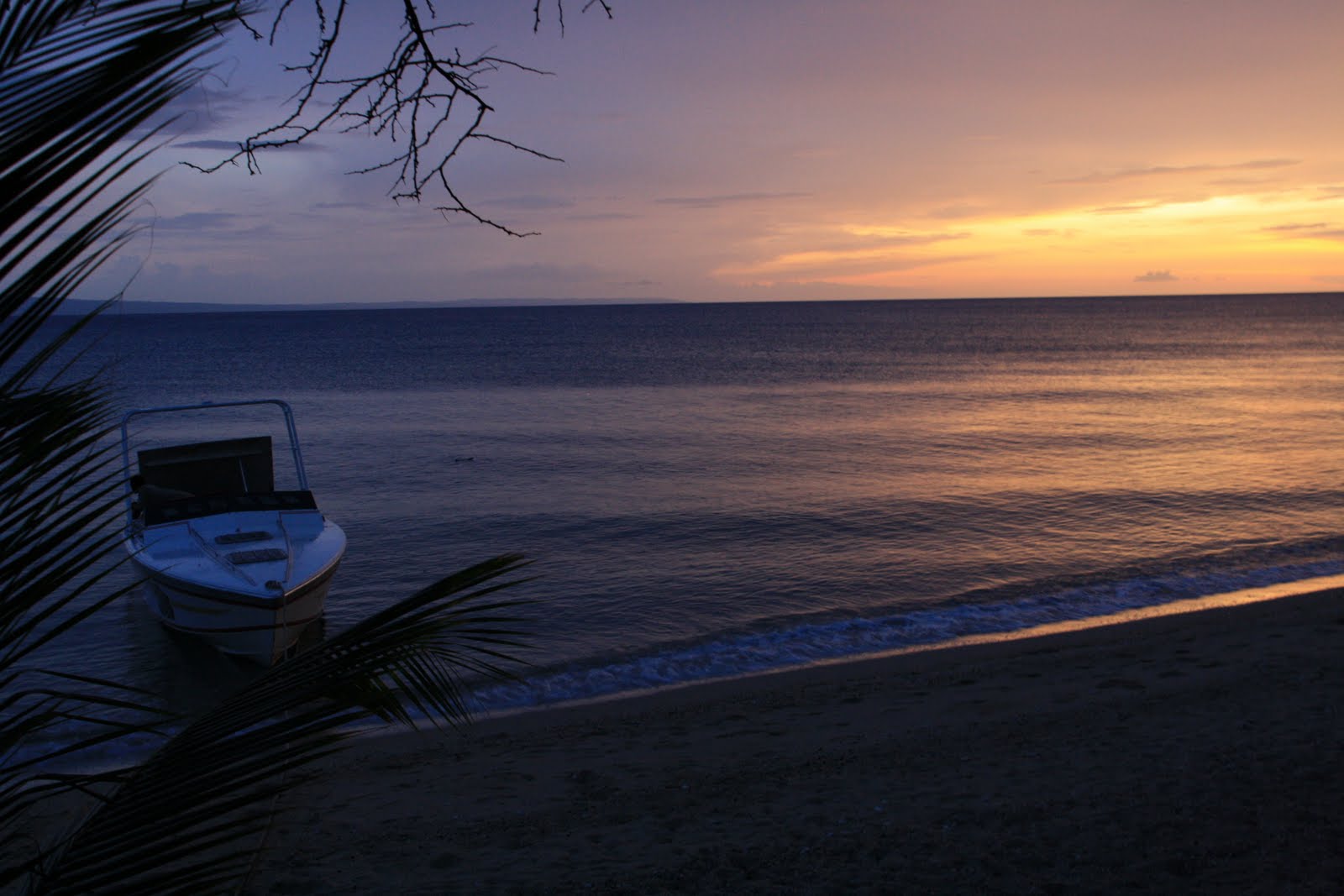
We ate dinner at the snack bar, which served greasy American foods like hamburgers and Cokes, and watched a movie at Elsie’s house. I snuck outside to watch the sunset on the ocean.

Breathtaking? Heck yes.

A boat was tied up just a short walk behind Elsie's home at Club Indigo.
The waters look so much more mellow at night than under the blazing equatorial sun.

The sunset was vibrant and so quick. The sun goes down here around 7, much
earlier than I'm used to since Haiti is so much closer to the equator than Louisiana.
The past couple evening the other three staff women from the U.S. have watched Friends episodes and painted their nails. A paraffin wax machine was, quite randomly, donated to the clinic from Christian Aid Ministries, so they’re planning on using it to sooth their calluses tonight.

The kids like Rihanna as much as Justin Bieber, and I’ve heard  “Oh nah nah, what’s my name…” sung from the cafeteria to the stoops of the water pump where the young men hang out and kick a semi-deflated soccer ball. Only snippets of the songs, never full verses.

A Haitian couple watched the sunset from the little raft off shore from Club Indigo's main beach.
I haven’t heard any American pop on the Haitian radio stations at Canaan, just Christian music in Creole, so I suppose they’ve heard the songs from the iPods and CDs of missionaries passing through. Katie said some Haitian radio stations play only American pop and rock, and many of the older Canaanites receive allowances for chores and good behavior to purchase their own laptops and iPods from the states. The DJ at Club Indigo today blasted techno versions of everything from Ke$ha to the Black Eyed Peas.

I’m in need of some silence right now. I am missing home a little bit. Making friends here is difficult because so many people pass through—and many goodbyes.

I’m praying for friendships and peace with my own transience.

At sunset, small motor boats hung their lanterns and bobbed between the mountains surrounding Club Indigo.

Thursday, July 14, 2011

Between mountains and sea: first day of clinic work

The view of the ocean from the hill above Montrouis. The clinic is just downhill to the left.
The scraggy dogs sleep all day under limping mimosas, but at night howl and moan and rustle past my bedroom window until sunrise. My day began at 6 am. I woke up covered in sweat, sun and stagnant heat but I slept peacefully through most of the night, with the occasional interruption from barking dogs.
The scrawny dogs that live at the bottom of the Canaan
hillside are constantly battling over territory with the
Canaan pastor's guard dogs.


After a breakfast of chocolate chip pancakes smothered in Medika Mamba (Creole for "peanut butter medicine"), the enriched peanut butter used to treat malnutrition. It's not much of a Haitian breakfast, but the peanut butter is a staple here, where Canaan houses 60+ orphaned children. 

Today was my first experience at the community clinic. The new building still needs a tremendous amount of construction and electrical wiring, but it’s functioning well. Three nurses and a doctor staff the clinic during the week, as well as several receptionists and “floaters” who take vitals staff the clinic and help with patient consults. Remembering names has never been my strength, so I'm trying to focus on meaningful introductions. Luckily, the staff speak French and some speak a little English, so I was able to communicate and learn some Creole phrases. It's amazing how harsh syllables are sometimes the only separation between Creole and swooning French.
View of the mountains surrounding Canaan, a short walk
uphill from my house.

Elsie, the clinic's head nurse, taught me how to take the patient's vitals before their consultations -- an extension of the clinic used to triage patients. For most of the morning, I weighed infants, helped elderly Haitians onto the scale to take their weight in kilograms, and took temperatures and blood pressure. When the trickle of patients halted, I filed in reception. It was daunting at first, with more than 17,000 patient files from the past three years are crammed into two filing cabinets, but I finished in time for lunch. 

It was difficult to communicate with patients with French alone, as the majority of Montrouis speaks only Creole. I need to improve my bedside manner -- a Bonjou is not enough to help assess patient needs. I did a lot of pointing, my own timid version of Creole I had overheard from the staff (and filled the rest in with French when I was unable to convey myself) to direct patients to the scale and to unbutton their sleeves for the blood pressure cuff. Haitians are friendly and to the point, especially when they come to the clinic. The smiles in Montrouis are infectious. 

I love it here.

There were not as many patients as there normally are, 60 versus the normal 80, so the clinic closed early. I went on a hour long hike with Amy and Robyn, volunteers from North Carolina who are leading the Canaan kids in a summer English reading program. Just up the hill from Canaan is a gorgeous view of the ocean. Villages sprawl from mountainside to the beach, elegant and haphazard. 
Villages scatter the mountains surrounding Canaan.

We followed a rock-paved road for a mile, and I saw a few mopeds hurl by crammed with 3 or 4 Haitian men and women and their groceries, clutching one another as they kicked up dust. A man on a donkey greeted us with a "Bonswa! Komon ou ye?" as goats wandered in the brush. I felt out of place with my camera strapped across my shoulder, looking like a blanc with my blond ponytail and grape-colored Keens. 

At dinner, I was able to speak French with the Haitian doctor, Jean Robert, and share a delicious meal of noodles with pieces of pepper, onion and raisins. Earlier at the clinic, I met Mis ("nurse") Marice, an LPN from Haiti who speaks French as her langue maternelle. It has helped build my confidence in the language, and has made it much easier to translate the patients' Creole. I could ask her to translate the Creole into French when English was not sufficient. Although I stumbled through my rusty French vocabulary, it felt fantastic to smile and laugh and talk about my life. It's a grounding experience to make a friend and delight in a language not my own. 

This is Canaan's cafeteria, where we eat all our meals.
Usually, we have to step over dogs in the process!
I am typing with some urgency because the generator is going to be shut off very early. The large generator that usually feeds Canaan electricity in the evening has broken down, so a tiny generator is burning the bulbs for the entire camp. There hasn’t been water in our house tonight, so I’ll make-do with the dredges of the laundry water and my spare bandana.

I'm off to bathe before the power goes, and the dogs claim the night. Bonwi.

Wednesday, July 13, 2011

Safe in Beautiful Montrouis

Lam veritab, the Haitian "bread fruit" we ate for
dinner tonight. Photo cred: http://www.haitiworld.net/index.php
I've arrived in Haiti. I'm safe, full of a delicious dinner and settling in the female staff house. Some of the kids who live at the orphanage have been following me shyly around, chanting my name mischievously. I can't wait to learn all their names, especially the spunky preteen who greeted me with a gut-squashing hug.

The flight from Miami to Port-au-Prince was full of expansive skies and layers of aqua, turquoise and lagoon blue waters. I've never seen so much depth to ocean. The Louisiana bayou has its particular muddy charm, but driving to Montrouis along the coast was like skirting trembling sapphire.

This is a beautiful country.

At Toussaint Louverture International Airport, I was one of the first passengers through customs because I had no checked baggage. I had to leave behind the toaster oven I brought for one of the nurses of Canaan at the airport lost and found because, to my surprise, the US has an embargo on any boxes to Haiti until mid-August. It was disappointing to leave behind the brand new appliance and frustrating, too -- especially because I was delayed 30 minutes simply searching for an official to help me find a place to leave the oven without causing a safety scare!

I boarded my flight to Miami at the last call and as the gates were closing. I was frantic and sweaty when I squeezed into my window seat. After a calming hour layover, I flew to Port-au-Prince next to a chatty Haitian student named Whitney. She's also a 21-year-old studying to pursue a career in medicine.

Whitney gave me an airborne "tour" as we flew over the wounded city -- fleets of white and tarp-blue tents, rusted tin roofs and thick, clay colored rivers. She sounded distant as she recalled how the landscape shifted since the earthquake, almost like she has been estranged from a close friend. She shook her head as we passed the neighborhoods still in ruins, but sighed whenever the gorgeous water framed the turmoil. The wing of the plane seemed to trace the edges of tumbling mountains, draping the landscape in patchy brown and green as we descended.

The driver was late to get the the airport, and I had no problems waiting in the shade until a large Haitian man grabbed me and tried to bring me "to my ride." I asked him who he was with, and he said "for your organization." He obviously was not with Canaan. When I refused, he walked alongside me and demanded a tip until, exasperated, he finally moved on to harassing another passenger.

A very kind British relief worker saw me awkwardly shuffling at the exit of the airport and offered to call Canaan for me. She spoke quick, succinct Creole with one of the staff members find out when my driver was coming. This allowed me to relax and calmly refuse the several taxi drivers who approached me, speaking a melodious jumble of French, English and Creole.

When my ride arrived, I learned quickly why they were late. Traffic in Haiti is unpredictable, and it seemed like there were no rules to the road. Drivers on tap-taps (little trucks with an overhang and benches that serve as crowded taxis) peeled out without warning. Large UN vans barreled treacherously between men on scooters and bicycles. The roads from Port-au-Prince were were rocky and jarring and I was dripping with sweat in the back of Canaan's truck (no AC, no rolled-down windows) for the two-hour drive to Montrouis. I fell asleep for a leg of the trip and woke up with a pool of sweat at the small of my back. Hello, equator!

We had a delicious dinner of Lam veritab, known as "bread fruit," baked with SPAM into a potato-like textured pie, as well as pasta with raisins and green beans. Although my stomach has been upset today from the anxiety of traveling, dinner was fantastic and soothing.

The generators were turned on around 6 as it started to get dark. I'm grateful for Internet access and the opportunity to let my friends and family know I'm happy and safe! I'm getting my mosquito net and bunk set up. Here are some pictures of my cozy setup.

The top bunk gets the most breeze, and away from the rats and critters!

My cozy bunk in the female staff house.


It's been thundering all evening and sprinkling on and off, but I'm enjoying the damp, salty humidity. It's finally hitting me I'm here: this is my home for the next 5 weeks. The rough-looking mutts littering Canaan have started howling, and I'm missing my little German shepherd puppy, Vivienne.

No pictures of Montrouis yet, although there have been so many times today my heart has ached for the camera I shoved, without batteries or a working memory card, in my carry-on. Woops. Those will come soon, though!

Thanks for your prayers! I'm praying for a beneficial transition into life here at Canaan, and hoping I can be used here at the community clinic in wonderful ways.

Bonwi, my friends.