Showing posts with label community clinic. Show all posts

Wednesday, July 27, 2011

Mango guts, melon cores and chunky Mamba thighs


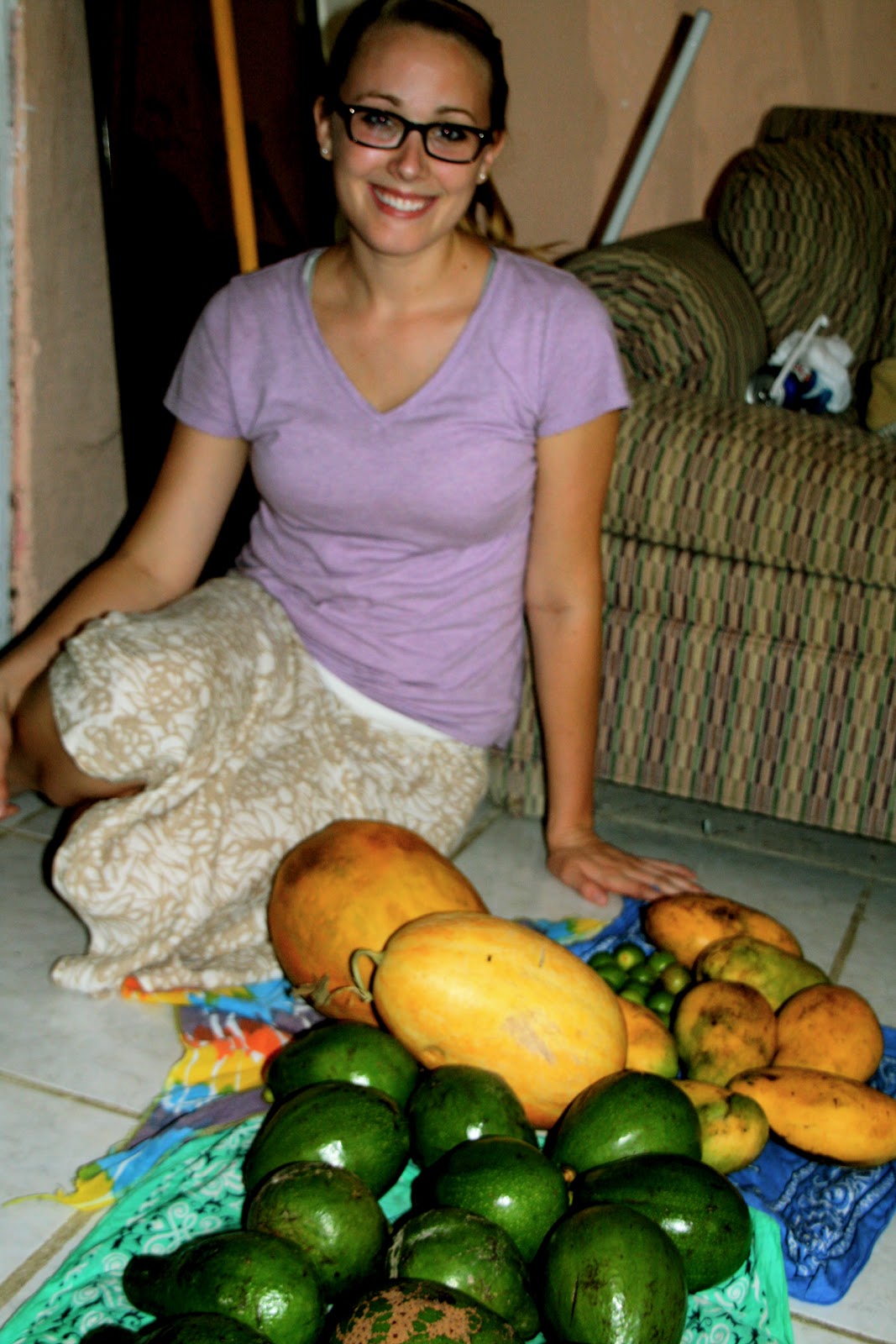
Posing with the fruit purchases... so happy!
Mangos smell rich and womanly under their soft yellow skins, sweet and steamy and damp like fresh mountain rain. Their perfume mesmerized me as I zigzagged through Montrouis’ open market, skirts swishing as women bargained and young boys begged, their hands held open like empty prayers.

After dulling my palate with two weeks of rice, pasta and white bread, the flavor almost choked me. There’s something embarrassingly sensual about biting into a mango, tearing the skin with your teeth. Juices dripped down my chin, and I felt like a child. Or a vampire, sucking zealously on raw flesh.

The texture of a mango is similar to a fine pâté once you get past the stringy bits near the skin. The hard core is a palm-sized heart, emerging from the goopy fruit almost alive, like the trembling meat in an oyster shell. I saw children sucking on the mango hearts like lollypops, leaving the cores smooth and brown.

I had never peeled a mango before, and some of the younger Canaan girls laughed as my fingers clumsily stripped the fruit to keep the precious orange heartstrings intact. The 12-year-old, Marceline, took the mango from me and stripped it meticulously with a knife, peeling it like a sweet potato. Under the swaying tungsten kitchen lights, the naked mango looked and felt like a slimy fist of raw chicken.
Our purchases from the market, minus a couple of mangos we couldn't wait to devour.

Caroline, the full-time director of the Medika Mamba malnutrition program in Montrouis arrived back at Canaan this week from a month-long hiatus. She picked up Creole after only four months mission work thanks to her background in French. I would have been lost without her navigation through the Montrouis fruit venders.

The key, Caroline said, was to play the vendors against one another and let them compete for business. We drove the Mamba truck to the middle of Montrouis to exchange USD for goudes. A bare-chested Haitian man lazily flicked at flies as he did the transaction: 800 goudes for $20 (40 goudes for every dollar).

The market starts on the curb of the winding highway of down-town Montrouis and extends a hair's length from honking tap taps or gestures of high-speed passers-by, filling the market with a stench of diesel. Haiti's Rte 1 cuts through the market's bustle, while a tangle of merchants with massive bowls or cracked tupperware aggressively wander like auctioneers. The more relaxed of the vendors sit under lopsided shelters, displaying everything from glass-bottled beverages to raw meat dizzy with flies.

As soon as we had money, women with huge bowls of melons, avocados, limes, mangos and spiky green and brown fruits I’ve never seen before swamped us. Unable to negotiate in the chaos, with fruits thrust under our noses and rubbed against our skin amid yells of “bon bagay!” (meaning, “good thing!” in Creole), we climbed in the truck and rolled down one of the windows. Caroline bargained ruthlessly, chastising the women as they advertised their wares at twice the street value to us blancs.

When we finally agreed on a fair price, the rapidly truck filled with fruit:

For $5 (US), we bought 13 plump, healthy avocados, picked that morning just miles down the road.

For $1, a handful of fragrant limes. For $2.50 a piece, two swollen and aromatic melons.

For $5, a bucket of mangos, warm from the afternoon sun, that made us drunk and salivating from sweetness.

Total price: $16 US, and we watched as two of the women strutted back home, finally selling all their goods after a long day at the market.

Caroline, Amy, Robin and I devoured the fruit, speaking only with “mmm”s and “ahhh”s.

The avocados need a few days to ripen, but with some garlic, lime juice, salt and pepper, we plan to make guacamole to eat on chips that a missionary team is bringing for us Saturday, per Caroline’s request. We prepared a fruit salad with the mangos and melon, juices marrying in a ceramic mixing bowl and nestled in one of Canaan’s industrial-sized refrigerators. I hope we can stretch it out over all our meals tomorrow, but we put such a dent in the mangos we might be back at market tomorrow.

Today was incredibly fulfilling, in addition to belly-filling. Canaan operates on routine, and I’ve fallen into the predictable cadence as I start my third week in Haiti. Wednesday means Medika Mamba at Rousseau, the rural hospital in the mountains. 

We had quite a few babies graduate from the peanut-butter based malnutrition program today at Rousseau, and Montrouis Tuesday. I love seeing emaciated babies transformed into giggling bundles of meaty arms and chunky thighs. We document these transformations with photographs, and the difference is astounding.

Graduation from the Medika Mamba program is the difference between shriveled, stunted bodies and those healthy rolls that make me smile. It’s death conquered by vitamins, protein and crucial calories.
Women and babies line up for Mamba assessments at Rousseau Hospital.
Twins get undressed to be weighed and examined.
I am exhausted, though. Caroline led us on a 2-hour hike into the mountains. My sweat glands were on overdrive as we climbed the steep rocky path. Like most afternoons, the air felt smarmy and damp and made my glasses slip incessantly down my nose. Out of nowhere, the mountains in the northeast echoed with thunder, and my sweat mingled with dense raindrops.

It’s so peaceful here, watching lightning blaze in the mountains while the coast is serene, untouched blue.

Thursday, July 21, 2011

Haitian hospitals, Medicine food and Creole lessons

Child with Kwashiorkor symptoms.
It has been a week and a day since I arrived in Haiti, but it feels like longer. There was a funeral at Canaan for a man of Montrouis, and I have part of the tune stuck in my head. It reminded me of a New Orleans jazz funeral –- several trumpets and a trombone player played a lively waltz rather than a somber melody. It was a colorful affair, which I peeked at through the steel-barred clinic windows.

I had my first Creole lesson today! Pastor Joelle’s wife taught us the Creole Alfabét, which is almost exactly the same as French, and some basic classroom vocabulary for the women working as English teachers.

Here are a few works of the day that will be useful for the clinic, especially when directing patients to their place while taking vitals:
Chita (la) = sit (here)
(Pa) kanpé la  = (don’t) stand here
Sòti  = go out
Rantré/ antré = come in
My morning was rather monotonous. Katie and I resumed cleaning the clinic storage room and sorting supplies that we think need to be donated to the local hospitals. I’ll be typing the list for Sister Gladys this weekend.

We had to put a lot of supplies in a trash pile for being either trampled in the chaos, covered in dust or bug bits, and some once-sterile containers chewed through by rats. It was also frustrating to see so many surgical supplies YEARS past the expiration date, thrown messily in rotting boxes. It’s fantastic that American medical supply companies are donating to Haiti, but medicines and wound prep kits “good until 2001” aren’t ideal.
View of the mountains through the Mamba truck window, on our way to Rousseau Hospital.

We sang along to Adele from my iPod Touch until our feet were gray from shuffling around in dust.

Here’s my reflection of the day: Why in the world would a rural primary care clinic need Foley catheters, sterile bone saws with leg amputation bags and around 1,000 surgical gowns? It may be a dream down the road to offer care in emergency situations, but for now Canaan doesn’t have the resources (or the space!) to store these supplies. They need to go where there’s a pressing need or them, like the hospitals in Pierre Payan, St. Marc and Rousseau, with specialty doctors on staff to address these needs. Otherwise they’ll end up like the pile we trashed—dirty, rat-eaten and unusable.

Yesterday I woke up with nausea and abdominal pain. I had to sit with my head between my knees so I wouldn’t start dry heaving at breakfast. The change in diet has disrupted my digestion, but who knows exactly what set it off. However, it was a busy day and I had no time to take it easy.

Doctor Jean Robert prescribed me some medication that the pharmacist, Henry, only gave me after teasing me in drawling French. Katie and I, along with Mis Elise and a translator from Canaan, hurriedly loaded the Mamba truck and drove 45 min to Rousseau, a hospital and health center deeper into the mountains than Montrouis.

It was the bumpiest drive I’ve ever been on. We passed a thick river, with naked children washing laundry and stretching linens to dry over skull-white stones. With their thumbs out like hitchhikers, people from Montrouis hailed us to stop so they could jump in the bed and catch a ride along the steep road.

The hospital was nice, but crammed with people waiting for consultations. We set up the Mamba supplies as mothers and grandmothers lined up on a crooked bench. Some of the children were so malnourished that their ages were indiscernible. A mother brought her 5-year-old son, smaller than the 2-year-old I babysit back home. He weighed a shocking 11 kg. An 8-year-old girl weighed only 14 kg, but could not be admitted into the Mamba program because of her age. The nurse gave her bags of rice. We also gave every family we saw to large bags of dehydrated soup – aid for parents as shriveled as their sick babies.

Here, food is medicine.

Rousseau Hospital. My camera was fogging up all day.
We admitted a new baby into the program that had severe edema (swelling) of his legs and belly. The edema is a symptom of Kwashiorkor, a form of malnutrition when the diet doesn't provide enough protein. He looked like a cartoon, his skin suctioned to his rib cage, while his legs and belly swelled like balloons. He was burning up with fever, but we were out of antibiotics. It was horrible feeling to let him leave without proper medication. 

We finished the Rousseau Mamba consultations at noon. After a quick lunch at Canaan, Katie and I drove one of the young mothers and her sick 6 mo. old baby to the hospital in St. Marc for a chest X-ray. A doctor living in the states who serves Canaan in his spare time agreed to take on the baby as a patient. She has strange dimples in her chest, as if her rib cage has been pushed too far back. There’s strangeness in the way it juts, and the baby sounds like she has pneumonia or some kind of lung infection.We didn't have to wait too long for the X-ray, and there were no lead coats for protection. I stepped outside to put a cement wall between my body and the radiation.

I saw my first Emergency Room in Haiti at the St. Marc hospital. It was a large room, smaller than a waiting room from one of the hospitals I work at in Baton Rouge. Mismatched beds were squeezed together like an infirmary. The room was hot and still, except for a single ceiling fan. I can't imagine laying in that stagnant heat for treatment.

I was exhausted and still felt sick after the long day. After dinner, I fell immediately asleep and did not wake up until 6 am this morning: 11 hours, through the generator being turned on and off, without moving. I’m feeling better, but the pain comes and goes.

Thursday, July 14, 2011

Between mountains and sea: first day of clinic work

The view of the ocean from the hill above Montrouis. The clinic is just downhill to the left.
The scraggy dogs sleep all day under limping mimosas, but at night howl and moan and rustle past my bedroom window until sunrise. My day began at 6 am. I woke up covered in sweat, sun and stagnant heat but I slept peacefully through most of the night, with the occasional interruption from barking dogs.
The scrawny dogs that live at the bottom of the Canaan
hillside are constantly battling over territory with the
Canaan pastor's guard dogs.


After a breakfast of chocolate chip pancakes smothered in Medika Mamba (Creole for "peanut butter medicine"), the enriched peanut butter used to treat malnutrition. It's not much of a Haitian breakfast, but the peanut butter is a staple here, where Canaan houses 60+ orphaned children. 

Today was my first experience at the community clinic. The new building still needs a tremendous amount of construction and electrical wiring, but it’s functioning well. Three nurses and a doctor staff the clinic during the week, as well as several receptionists and “floaters” who take vitals staff the clinic and help with patient consults. Remembering names has never been my strength, so I'm trying to focus on meaningful introductions. Luckily, the staff speak French and some speak a little English, so I was able to communicate and learn some Creole phrases. It's amazing how harsh syllables are sometimes the only separation between Creole and swooning French.
View of the mountains surrounding Canaan, a short walk
uphill from my house.

Elsie, the clinic's head nurse, taught me how to take the patient's vitals before their consultations -- an extension of the clinic used to triage patients. For most of the morning, I weighed infants, helped elderly Haitians onto the scale to take their weight in kilograms, and took temperatures and blood pressure. When the trickle of patients halted, I filed in reception. It was daunting at first, with more than 17,000 patient files from the past three years are crammed into two filing cabinets, but I finished in time for lunch. 

It was difficult to communicate with patients with French alone, as the majority of Montrouis speaks only Creole. I need to improve my bedside manner -- a Bonjou is not enough to help assess patient needs. I did a lot of pointing, my own timid version of Creole I had overheard from the staff (and filled the rest in with French when I was unable to convey myself) to direct patients to the scale and to unbutton their sleeves for the blood pressure cuff. Haitians are friendly and to the point, especially when they come to the clinic. The smiles in Montrouis are infectious. 

I love it here.

There were not as many patients as there normally are, 60 versus the normal 80, so the clinic closed early. I went on a hour long hike with Amy and Robyn, volunteers from North Carolina who are leading the Canaan kids in a summer English reading program. Just up the hill from Canaan is a gorgeous view of the ocean. Villages sprawl from mountainside to the beach, elegant and haphazard. 
Villages scatter the mountains surrounding Canaan.

We followed a rock-paved road for a mile, and I saw a few mopeds hurl by crammed with 3 or 4 Haitian men and women and their groceries, clutching one another as they kicked up dust. A man on a donkey greeted us with a "Bonswa! Komon ou ye?" as goats wandered in the brush. I felt out of place with my camera strapped across my shoulder, looking like a blanc with my blond ponytail and grape-colored Keens. 

At dinner, I was able to speak French with the Haitian doctor, Jean Robert, and share a delicious meal of noodles with pieces of pepper, onion and raisins. Earlier at the clinic, I met Mis ("nurse") Marice, an LPN from Haiti who speaks French as her langue maternelle. It has helped build my confidence in the language, and has made it much easier to translate the patients' Creole. I could ask her to translate the Creole into French when English was not sufficient. Although I stumbled through my rusty French vocabulary, it felt fantastic to smile and laugh and talk about my life. It's a grounding experience to make a friend and delight in a language not my own. 

This is Canaan's cafeteria, where we eat all our meals.
Usually, we have to step over dogs in the process!
I am typing with some urgency because the generator is going to be shut off very early. The large generator that usually feeds Canaan electricity in the evening has broken down, so a tiny generator is burning the bulbs for the entire camp. There hasn’t been water in our house tonight, so I’ll make-do with the dredges of the laundry water and my spare bandana.

I'm off to bathe before the power goes, and the dogs claim the night. Bonwi.