Showing posts with label medical anthropology. Show all posts

Wednesday, March 21, 2012

Next stop, medical school

Four years from now, you can call me Dr. Piche. Seriously.  

I was accepted into Bastyr University's naturopathic medicine doctoral program, which starts mid-September. As I've continued to adopt a more minimalist lifestyle and non-toxic approach to food, my view on wellness has profoundly changed to celebrate non-invasive, natural therapies over the mass drug prescriptions that dominate conventional medicine.

 I'm sailing new waters: dreamy beach-view of the St. Marc Channel in Montrouis, Haiti.
Bastyr quickly replaced University of Texas as my top choice medical school, especially after discovering their dual-track program in naturopathic medicine and midwifery. My dream is to open a women's wellness center and offer a home birth/ natural birth practice as well as mother-newborn care. 

Back two years ago when I decided to pursue my original goals for medical school and OB/GYN specialization, I took a medical anthropology class at LSU called Medicine Body Power. It has been one of the most valuable classes I have taken as an undergraduate, because before then I hadn't ever studied conventional medicine and seen it for what it truly was -- a cultural medicine that operates for profit (Western medicine/ biomedicine). 

We studied complementary and alternative medicine, Chinese/oriental medicine, homeopathy and naturopathy among a variety of other forms of cultural medicine, and the desirability of biomedicine diminished.

As a minimalist woman devoted to effective, affordable preventative therapies and lifestyle change through nutrient dense foods and exercise, I was jaded after two years of working in the emergency room and wanted out. I didn't want to pump my patients' bodies with drugs to suppress symptoms. I wanted to heal, to treat the root of the disease, and to treat the whole person. But the options in Louisiana to pursue a career in natural medicine are slim. Naturopathic doctors cannot even obtain licensure in Louisiana!

My medical anthropology class launched an investigation into America's shady birthing industry, and the documentary The Business of Being Born was a revelation -- I could still deliver babies and heal women as a midwife and naturopathic doctor, without the toxic drugs and invasive, often unnecessary surgeries. When I found Bastyr's medical program, everything fell wonderfully into place. 

Don't get me wrong-- I have an immense amount of respect for biomedical doctors. In fact, after Bastyr, I am planning to attend a fast-track general practitioner MD program so I can practice natural and holistic medicine in the south. I just believe in many cases, biomedical treatment emphasizes symptom suppression over disease treatment and ignores the implications of poor lifestyle habits, especially because food is medicine. 

Fast forward: In only a few months, I'll be packing my trunk with all my possessions and moving 2,500 miles to Washington state. It's not easy going against the norm. But I found something I'm passionate about, and I'm willing to move cross-country and go horrendously into debt to follow that passion.

Weighing a baby at the mobile malnutrition clinic. Montrouis, Haiti.
I'll be graduating this summer with my degrees in mass communication and anthropology, so finally completing my pre-med prerequisites, landing an interview, and receiving my acceptance letter came in a delightful, life-changing whirlwind. Working at the medical clinic in Montrouis, Haiti this past summer was an incredible experience, and I plan to return better equipped with a solid education in primary care and general medicine, as well as training in natural birthing and midwifery.

The direction of my blog is changing after many months of downsizing and preparing for Bastyr. I hope I can share my latest endeavors in minimalism, medical school, and frugal green living, especially as I take on the challenge of moving with only the things that fit in the trunk of my car.

Monday, August 8, 2011

Foreigners at Pierre Payen Hospital: Mamba babies and medical specialists

Scuttling, scraping daggers on the tin roof. The rats are active again. The sound makes me cringe and uneasily eyeball the cracks in the cement walls of our tiny house.

It’s a cool, mournful evening after the first rain in a week.

I feel stressed out today—this week has a sense of urgency, especially as my time left in Haiti dwindles. The clinic is in serious need of an organizational overhaul, and not just for supplies and storage. The staff is incredibly busy, but without an administrator, it is not operating efficiently. I’m praying it will get better, because today reception turned away several sick babies and elderly people. The doctor was home in Port-au-Prince with a cold, leaving only two nurses to see all patients.

There is a team of American doctors and Canadian nurses visiting the hospital in Pierre Payen until Sunday, including a pediatric urologist and orthopedic surgeon.

Caroline and I have a lot of time to pay to Haitian waiting rooms.

We woke up earlier than usual to rally the moms of babies in the Medika Mamba program requiring extra medical care. It was hotter than ever, and even with the raspy air conditioning, the truck reeked of sweat.

I hardly notice the smell anymore, this pungent perfume of hot bodies. But today it made me pine for ice water and a swimming pool… And some Febreeze.

Perre Payen Hospital has a homey guesthouse and a large, well-constructed facility with high walls and breezy ventilation. Once we were admitted past the guard at the iron gates and thrust among waiting patients (some sitting, most standing, but all cramped in the hallway clutching their files), a nurse arrived to sort the babies to specialty doctors and therapists based on their needs.

The hospital examination rooms were roomy, but sparsely supplied, painted in the surprisingly antiseptic hue of yellowing newspaper. The orthopedic doctor had only an exam table, a wheelchair, basic orthopedic wraps and an x-ray machine. The urologist had an examination table and a packet of sterile gloves, seeing patients behind blue surgery drapes pinned above the doorway like flapping laundry.

The foreign staff walked fiercely from room to room, hair frizzed and sweat rolling. It was funny to watch them move while Haitians patiently waited, falling their faces with manila envelopes containing scribbles of their insides and histories of their pain. More than once, I was grabbed and asked to translate. I am sorry I had to refuse them. I am trying to hard to wrap my brain around Creole, even with my French language background.

James is a 13-month-old with an ectopic bladder. His condition requires multiple specialized surgeries to repair his bladder and reconstruct his genitalia. He lives in Sous Bogne, the little community below Canaan, and in a previous post I talked about my visit to his home with Katie my first week in Haiti. He has been rejected from two hospitals in the states already for lack of funding, especially because he will need a lot of recovery time and after care following his surgeries. As the pediatric urologist examined him, we were told nothing new… except that he is at the perfect age for surgery and that his condition is treatable. The doctor said it will be almost impossible to treat him in Haiti, and offered his contact information for his hospital in Nebraska.

Please pray that James’ surgery will be accepted and covered by this doctor’s hospital. He will need to stay in the states for a while, accompanied by someone from Canaan because it will take months for his mother’s birth certificate to be found in the Haitian national archives. James needs the surgery now, and Haitian time is slow time. I wanted to throw up my hands and scream when the doctor explained the specific microscopes her needed for an effective surgery and recovery.

Haiti doesn’t have this type of medical care readily available, especially not for babies in poverty.

A little girl, Gueraldine, has had severe joint malformations. She was discontinued from the Medika Mamba after failing to gain weight, but she’s still scrawny and malnourished. After she fell in February, her wrists began to jut abnormally, which was formerly diagnosed as untreated breaks.

The orthopedic surgeon who examined Gueraldine today gave some clarity—it’s a congenital condition, and the x-rays revealed missing bones in her hands and wrists. The doctor and physical therapist were able to mold her two removable splints out of casting. It was painful to watch the baby scream as they pushed her angular wrists into normal positions and wrapped them tightly. However, it was a relief to learn simple stretches the mother could perform to aid in proper growth and development. Plus, the baby doesn’t need extensive surgery, which was a relief to the mother and us—less letdowns and hoop jumping this way.

The Haitian doctor Jean Robert was expecting a pediatric cardiologist to be with the team of Americans, so the 5-year-old requiring heart surgery for her defect was turned away. She’s been waiting for 2 years now to see a pediatric cardiologist with the means to operate in Haiti. Unfortunately, the specialty equipment is difficult to come by, especially for short-term doctors and surgeons.

Since the team does have a general doctor to see all the patients that don’t fall into the available specialty categories, there’s another baby at Rousseau with a chest and lung malformation will still need to be looked at, although our hopes of specialist treatment are dashed. After the Mamba mobile clinic Wednesday, we’ll be bringing the mom and the x-rays we obtained in St. Marc to wait once again in Pierre Payen.

Waiting, waiting and more waiting. It’s so difficult for me to sit still and accept that this is how life rolls in Haiti.

People die waiting.

Caroline and I vented with M&Ms and danced the cha cha with some of the younger girls, Magdalena and Jessica. It was my first genuine smile of the day, besides entertaining the babies in the sticky hospital heat. Thank you to chocolate and my fiesty Haitian friends.

It’s only 8:30, but I want to just lie in bed and decompress. I need a massage, but I'll settle with some IB profen for now. The mosquitoes are munching.

Wednesday, July 27, 2011

Mango guts, melon cores and chunky Mamba thighs


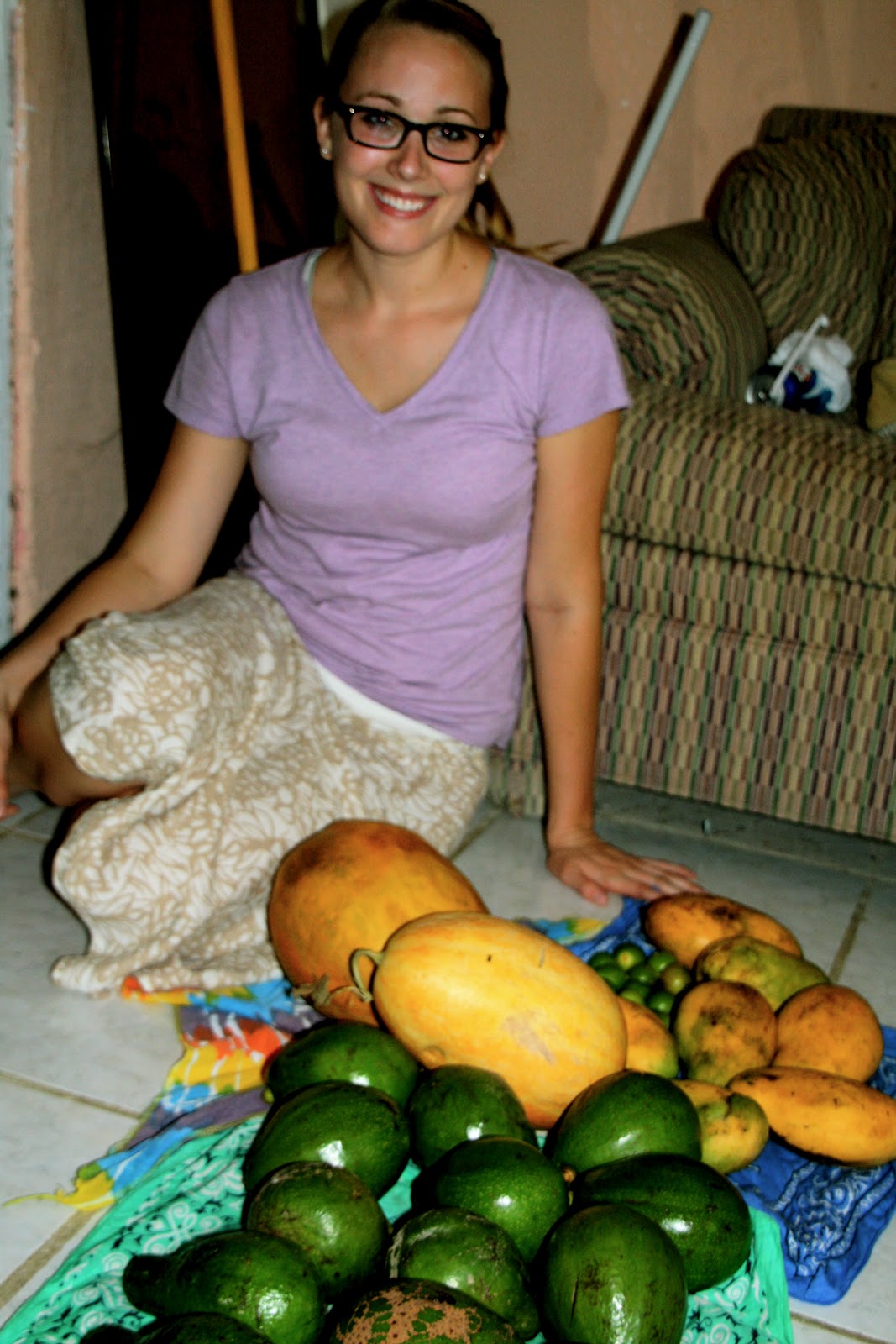
Posing with the fruit purchases... so happy!
Mangos smell rich and womanly under their soft yellow skins, sweet and steamy and damp like fresh mountain rain. Their perfume mesmerized me as I zigzagged through Montrouis’ open market, skirts swishing as women bargained and young boys begged, their hands held open like empty prayers.

After dulling my palate with two weeks of rice, pasta and white bread, the flavor almost choked me. There’s something embarrassingly sensual about biting into a mango, tearing the skin with your teeth. Juices dripped down my chin, and I felt like a child. Or a vampire, sucking zealously on raw flesh.

The texture of a mango is similar to a fine pâté once you get past the stringy bits near the skin. The hard core is a palm-sized heart, emerging from the goopy fruit almost alive, like the trembling meat in an oyster shell. I saw children sucking on the mango hearts like lollypops, leaving the cores smooth and brown.

I had never peeled a mango before, and some of the younger Canaan girls laughed as my fingers clumsily stripped the fruit to keep the precious orange heartstrings intact. The 12-year-old, Marceline, took the mango from me and stripped it meticulously with a knife, peeling it like a sweet potato. Under the swaying tungsten kitchen lights, the naked mango looked and felt like a slimy fist of raw chicken.
Our purchases from the market, minus a couple of mangos we couldn't wait to devour.

Caroline, the full-time director of the Medika Mamba malnutrition program in Montrouis arrived back at Canaan this week from a month-long hiatus. She picked up Creole after only four months mission work thanks to her background in French. I would have been lost without her navigation through the Montrouis fruit venders.

The key, Caroline said, was to play the vendors against one another and let them compete for business. We drove the Mamba truck to the middle of Montrouis to exchange USD for goudes. A bare-chested Haitian man lazily flicked at flies as he did the transaction: 800 goudes for $20 (40 goudes for every dollar).

The market starts on the curb of the winding highway of down-town Montrouis and extends a hair's length from honking tap taps or gestures of high-speed passers-by, filling the market with a stench of diesel. Haiti's Rte 1 cuts through the market's bustle, while a tangle of merchants with massive bowls or cracked tupperware aggressively wander like auctioneers. The more relaxed of the vendors sit under lopsided shelters, displaying everything from glass-bottled beverages to raw meat dizzy with flies.

As soon as we had money, women with huge bowls of melons, avocados, limes, mangos and spiky green and brown fruits I’ve never seen before swamped us. Unable to negotiate in the chaos, with fruits thrust under our noses and rubbed against our skin amid yells of “bon bagay!” (meaning, “good thing!” in Creole), we climbed in the truck and rolled down one of the windows. Caroline bargained ruthlessly, chastising the women as they advertised their wares at twice the street value to us blancs.

When we finally agreed on a fair price, the rapidly truck filled with fruit:

For $5 (US), we bought 13 plump, healthy avocados, picked that morning just miles down the road.

For $1, a handful of fragrant limes. For $2.50 a piece, two swollen and aromatic melons.

For $5, a bucket of mangos, warm from the afternoon sun, that made us drunk and salivating from sweetness.

Total price: $16 US, and we watched as two of the women strutted back home, finally selling all their goods after a long day at the market.

Caroline, Amy, Robin and I devoured the fruit, speaking only with “mmm”s and “ahhh”s.

The avocados need a few days to ripen, but with some garlic, lime juice, salt and pepper, we plan to make guacamole to eat on chips that a missionary team is bringing for us Saturday, per Caroline’s request. We prepared a fruit salad with the mangos and melon, juices marrying in a ceramic mixing bowl and nestled in one of Canaan’s industrial-sized refrigerators. I hope we can stretch it out over all our meals tomorrow, but we put such a dent in the mangos we might be back at market tomorrow.

Today was incredibly fulfilling, in addition to belly-filling. Canaan operates on routine, and I’ve fallen into the predictable cadence as I start my third week in Haiti. Wednesday means Medika Mamba at Rousseau, the rural hospital in the mountains. 

We had quite a few babies graduate from the peanut-butter based malnutrition program today at Rousseau, and Montrouis Tuesday. I love seeing emaciated babies transformed into giggling bundles of meaty arms and chunky thighs. We document these transformations with photographs, and the difference is astounding.

Graduation from the Medika Mamba program is the difference between shriveled, stunted bodies and those healthy rolls that make me smile. It’s death conquered by vitamins, protein and crucial calories.
Women and babies line up for Mamba assessments at Rousseau Hospital.
Twins get undressed to be weighed and examined.
I am exhausted, though. Caroline led us on a 2-hour hike into the mountains. My sweat glands were on overdrive as we climbed the steep rocky path. Like most afternoons, the air felt smarmy and damp and made my glasses slip incessantly down my nose. Out of nowhere, the mountains in the northeast echoed with thunder, and my sweat mingled with dense raindrops.

It’s so peaceful here, watching lightning blaze in the mountains while the coast is serene, untouched blue.

Tuesday, July 19, 2011

Mamba clinic, tap taps and collossal clutter

 
More than 100 patients checked in at the Centre de Santé Nouvelle Jerusalem since 6 am. By 1:21 pm, 75 were still waiting to be seen by a nurse or doctor. 
The numbers alone were discouraging. As much as I am an aspiring med student, I don’t have the credentials to step in and help see patients. I know I am needed in other areas, but helplessness pains me.

The clinic is understaffed, especially on Tuesdays and Thursdays when the Mamba clinic is open. I helped Katie and Mis Joanne, the RN who runs the malnutrition program year-round, weigh babies and check-in children (aged 4 and under) who qualified as malnourished to participate in the 8-week program.

This little pink house is perched on the hill above the clinic. Empty, but with an amazing view.
Depending on the child’s weight that week, they receive lime-green plastic pouches of Mamba: essentially peanut butter and vitamins. It was disappointing to see some graduates of the program once again returning as malnourished.

It’s absolutely crazy to me, but the program never worries about peanut allergies. There are none. Katie told me that when the babies are malnourished, they have no immune system. Without a functioning immune system, there are no allergies.

Christian Aid Ministries (CAM) made a delivery of medicine, which lifted our moods and even made the stern pharmacists smile. Katie left for an hour, and I took some infant patients on my own. Scary, in the sense that I was expected to pick up the process immediately, but also exciting!

The communication barrier has crumbled a bit today, too. I’ve picked up little phrases in Creole, and Christiane, one of the girls from Canaan, translates at Mamba each week. It was immensely helpful when explaining the program to the new Mamba initiates. Sister Gladys got back from the states yesterday evening, and she has promised to start daily Creole classes for the American staff. I’m starting to feel at home here, and I’m so encouraged to have a willing teacher.

When I finished taking vitals and checking patients in, my final number resting around 104 with people still registering. People are usually turned away at number 80 or so, except for children and elderly. But today that’s all I saw – mothers cradling their babies too sick to cry. An old woman curled into the fetal position on the concrete slab of sidewalk, ending abruptly at a field where goats and chickens wandered.

I heard one of the nurses whisper in exasperation, “We have an old woman outside, dying before she sees the doctor!” I felt so frustrated that there was no way to speed it up.

The shaded waiting area was too packed with others, like the old women, sick and waiting. They possess a disturbing patience with the slow-progressing consultations, something I hardly see at the Baton Rouge hospitals.

I suppose it’s better than the alternative: Nothing.

Today was also the start of a colossal inventory of the clinic’s supply room(s).  The clutter was overwhelming. Katie and I spent a few hours of lunch digging through boxes of IV fluids, bandages, 52 pairs of crutches, and misc. medicine bottles (some in Hungarian!) among other things.

The storeroom is a classic example of how a plethora of cluttered medicine and supplies can actually limit resources. The staff often has no idea what medicines are available to treat patients. Katie told me that last week, there were several instances of antibiotic creams and medicines found only days after patients were sent away empty-handed.

There are stacks of surgical equipment and specialized machinery delivered in CAM shipments useless to the rural clinic. It might be better off donated to a Haitian hospital than gathering dust and bug casings.

If there’s a shortage, it’s in organization. I need patience if Sister Gladys passes this job onto me when Katie goes back to the states Sunday.


Here are a few photos of the chaos: 


On Monday, I finally had the chance to check over the EKG machine that’s been gathering dust in the X-ray room at the clinic. With the X-ray stuck in a shipment of necessary medical supplies in customs at Port Au-Prince (2 years as of this summer!), the room is used for spillover storage of supplies. It’s missing leads and the clinic has no electrodes to use. Unless they find parts, it’s useless. I would love to see the clinic receive a gently used EKG machine for the clinic. There are a lot of heart patients in Montrouis.
Burning garbage is becoming a familiar smell in Haiti.
Although the clinic was busy, I tap-tapped with the three staff women into St. Marc, about 30 minutes of lush land and sweaty bodies squashed together, thigh-to-thigh. We needed cleaning supplies for our non-flushing toilet, and I needed to exchange some dollars into Haitian goudes. The sickly sweet smell of burning plastic smoked the streets. The entire population spilled onto the streets, selling every kind of car part and mattress size and cell phone charger and bootlegged French film imaginable.

I mostly walked with my head down, watching my feet as the sidewalk became a sludgy ditch, a potholed reserve of rancid water, and a muddy slope of garbage. We walked, in line formation, straight to the grocery store and back from the tap-tap station.
Horrible green facials from our impromptu spa night.


I enjoyed St. Marc, but felt like a circus act with my loose blond hair. Strangers reached out to pat my head, poke my arm and pull at my plastic bag of snacks. I would not have felt very safe without Jacques, a 19-year-old from Canaan who went along to translate and chaperone. We returned and immediately treated our blackened feet to a dip in the paraffin wax machine. Impromptu spa night, complete with masques one of the missionaries left behind!

The sun has gone down and I’m getting mauled with mosquitoes right now, so time to reapply nasty deet to my body. The “all natural” repellant doesn’t work for me against these tiny heathens (they really are smaller than any ones from Louisiana!). Katie and Amy baked a chocolate bundt cake, so we invited the doctor Jean Robert and a couple of the older boys to help us enjoy it in the garden next to our house.

It could just be the scenery talking, but chocolate tastes so divine here.


Enjoying cake in the garden, while I hid behind the camera!

Thursday, July 7, 2011

Packing Light: Long-term medical mission work in Haiti

Backpacking at Mont St. Michel in France.
Everything I brought to Europe for the
winter in 2010 fit in my Osprey pack.
Six days left until I'm on a plane to Haiti. Fundraising put me at exactly where I needed to be -- $3,000! St. Paul Lutheran Church donated the last $1,000 leg needed to cover trip costs. I'm elated and ready to work.

I have almost finished packing. I decided early on not to check any bags with plane changes/ long layovers. I spent last winter in France and Hungary with about 15 lbs in my backpack, including food, heavy wool coat, sturdy leather boots, travel books and lots of layers. It saved a ton of money when I flew on the budget airlines (RyanAir and EasyJet), which all charge for checked bags.

My Osprey Aura 50 backpack is just under 3,000 cubic inches, but cinches down to fit into a small overhead compartment. It's much lighter than my old Osprey pack, which was great for long treks in my Girl Scouting days but not ideal for light traveling.

In Haiti, the average summer temperature ranges from 77 to 95 degrees, so I'm going to need less layers and lighter fabrics. My old apartment did not have reliable air conditioning, but I've been spoiled by central air after weeks of house sitting... It's time to get used to the heat again!

Since Canaan requires modest female clothing (no shorts), I found some breezy cotton summer skirts at Goodwill for less than $7 a piece. Everything fits in my pack with plenty of room left over--I'm shooting for less weight than my trip to Europe. However, the extra weight of bed linens is pushing me past my desired pack weight.

I was originally only going to bring 2 outfits to alternate, but I've since changed my mind. I'm not sure how easy it will be to do laundry. I want to be respectful of the locals and dress neatly. Hygiene is a priority for Haitians (and myself), so I am packing heavier than I would for 5 weeks in Colorado back-country. Plus, I plan to leave the majority of my clothes as donations to Canaan.

Here's my packing list for 5 weeks in Montrouis, Haiti (July-August). 
Note: This list works for longer trips as well. 

Clothes/Linens:
4 long cotton skirts from Goodwill (nicer one for church/ traveling)
6 cotton t-shirts
2 white undershirts
1 pair Patagonia baggie shorts for the beach
1 tank-top for weekend lounging
1 pair comfy socks
PJs (yoga pants and a comfy shirt)
Undergarments (undies/bra)
Bathing suit
Bandana & hair stuff
Microfiber camp towel
Twin sheets (& my tiny pillow splurge)
Keen closed-toe Whisper Sandals
Chacos

Toiletries:
Toothpaste/ Toothbrush
All-natural toothpaste
Hand sanitizer
Baking Soda Deodorant (baking soda also relieves itching)
Sunscreen
Aloe Vera Oil (for burns, bug bites & dry skin)
Small Mosquito Repellant with Deet & a larger all-natural bug repellant to dilute
Doxycycline/ antibiotics (An anti-Malaria Rx)
Misc. First Aid items (Neosporin, Benadryl, headache medicine & probiotic digestive aids)

Other:
Passport
List of important phone numbers, copy of passport
Mosquito net
Laptop
Canon Rebel camera
Small battery-operated fan
Laundry Line
2 Water bottles
Headlamp
Ear plugs
Book
Bible
Journal & pen
iPod
Cords/ chargers/ batteries for gadgets

Traveling with contact lenses is a hassle, so I'm just going to stick to wearing my glasses the entire trip. I can bring my case/ back up pair and not have to worry about contact lens case, disinfectant & cleaning fluid, eye drops because contacts irritate my eyes, and replacement lenses. That's another pound or two of gear! The only downside is that I'll have to ditch my non-prescription sunglasses from my pack and rely on sunscreen and a bandana/hat for sun protection

It seems like a lot of stuff listed out, but the little items pack into a very small space. Everything fits in my backpack! Here's a slideshow of the items I'm bringing. The picture with my toiletries was deleted on accident, so another will be posted soon! Enjoy.


Thanks for checking out my blog, for your support and for helping my fundraising efforts be such a success! Please feel free to offer your packing advice and any tips for how I can pare down more!

Love.

UPDATE: One of the wonderful nurses at Canaan has asked me to bring a toaster oven to her new home in Montrouis. (It costs around $39 new at Walmart versus $100 in Haiti with shipping.) Since my backpack is my carry-on, I can take toaster oven as my one free checked bag. Perfect! Light packing pays off.

Tuesday, April 26, 2011

MINUSTAH: My lasagna dinner with a representative from the United Nations in Haiti

United Nations emblem.
I received an e-mail Sunday from a family at St. Paul Lutheran Church inviting me to share dinner with them and their house guest--a man who works for United Nations from Port au Prince, Haiti. His name is Emmanuel, and he is Minustah de la Mission des Nations Unies pour la Stabilisation en Haiti, or the United Nations Stabilization Mission in Haiti.

Although Emmanuel is a native of the Republic of Burundi, he has been working in Haiti for several years in telecommunications. It was so wonderful to talk to him about Haitian culture, political affairs & Haiti's newly elected president (popular musician Michel Martelly), reconstruction after the earthquake, and NGOs in Port au Prince. He said that from his experience, Port au Prince is "not a problem" and not dangerous for travelers as long as I do not wander alone in the "red zones" or accept a ride from someone I do not know when I arrive at the airport. This is reassuring to hear from someone involved with the police in Port Au Prince.

Emmanuel's native language is French, and striking up a conversation in French helped overcome some communication barriers, though we mostly talked in English (and reminded me how rusty I've become since my month-long backpacking trip in France!). He said that being a French speaker allows him to understand Creole very well, the official language of Haiti, so I definitely need to intensively work on my conversational French. French is mostly spoken by the Haitian educated elite and remains the language of politicians, whereas Creole is spoken by the majority of the general public.

On a different note, I have been kicking myself all morning for forgetting to take a picture to share with you all! After all, I started a blog to streamline my experiences into a cyber scrapbook, with both the blurbs and visuals. I'll be sure to take advantage of the photo opportunity when I meet Emmanuel again this summer in Port au Prince. He will be working during the months I'm in Haiti, so we're planning on meeting again.

I'm so grateful to have a friend from Haiti with whom I've shared a meal and good conversation. It makes me feel like less of a stranger to the country knowing he will be working in Port au Prince during the months I will be serving Canaan in Haiti. I'm looking forward to new friendships and the enjoyment of new cross-cultural experiences!

Edit (4/29): Here's the fundraising update for the end of April!

Sunday, March 27, 2011

Destination: Montrouis, Haiti

First off, thank you everyone for your tremendous support. I've received an overwhelmingly positive response towards my month and a half medical mission to Montrouis, Haiti this summer. I'm grateful for all your generosity and graciousness! It's such a blessing to be provided for, and to have this opportunity. Your donations are truly bringing me closer to Haiti, but I have a long way to go.

Click here for pictures of life an Canaan Christian Community.

Here's a little taste of Haitian history and background on Montrouis:

Since the 7.0 magnitude hurricane ravaged Port-au-Prince on Jan. 12, 2010, many people found themselves homeless. Homes, businesses, Parliament and the Presidential palace were reduced to rubble. Many children became newly orphaned, either because their families were among the estimated 220,000-318,000 killed, or because their parents were no longer able to take care of them. Haiti has suffered from various acute diseases, such as cholera, from contaminated water sources--especially difficult to eliminate with the estimated 1.6 million Haitian people packed in slums. In the more rural areas surrounding Port-au-Prince, malnutrition is prevalent.

Montrouis is a town located on the coast in western Haiti.

Here's some information from Canaan and their mission in Montrouis:

Canaan Christian Community was established in 1991 as a community of Christians that welcome people who need a place to belong. Most of the 110 residents are children who either do not have parents or whose parents are unable to provide care for them for various reasons. The leaders of the community strive to provide a safe haven for all who live or visit here. God has blessed us with facilities to provide a comfortable home for both residents and guests. Canaan is designed to be a place of peace and preparation. The founders and current leadership at Canaan is Pastor Henry and Sister Gladys.

The community is located near the town of Montrouis, approximately 80 kilometers north of Port Au Prince, the capital of Haiti. Guests from North America usually fly into the international airport in Port Au Prince and are met by Canaan staff. It takes approximately an hour and thirty minutes to make the trip from the airport to Canaan.

Canaan Christian Community is built on a hillside near the national highway overlooking the Caribbean. The hillside surrounding Canaan is dry desert just like Canaan was when the community was first established in 1991. Since then, God has blessed the planting of trees that has resulted in Canaan being the only shaded community in the area other than directly on the seaside. The buildings consist of dormitories for boys and girls, staff homes and guest facilities. Recently, the government has provided periodic electricity for the area. Generators provide electricity in the evenings when the government electricity is not available. There is usually no electricity available during the daylight hours. Drinking water is hauled in by Canaan staff and put through a purification system. Water for washing, bathing, etc. comes from a well on the property that is not used for drinking water.

Meals are served to the children and the staff in an outdoor, covered cafeteria. Meals prepared by the cooks, consist of simple but delicious food that the Lord provides through the donations of friends of Canaan. Rice and beans are the staple food along with local fresh vegetables that are served when funds are available. Meat is very expensive in Haiti and not as readily available as in North America.

My stay in Montrouis will cost $15 per day to offset the costs of food, lodging and transportation to and from the airport, which is an hour and a half away in Port-au-Prince. If you're interested in a tax-deductable donation, you can send me a check made out to Canaan Christian Community, which will all go towards living expenses during the time I'm in Haiti.If you have any questions or want to be notified via e-mail whenever I update my blog for my trip, or during my trip in the future, please contact be at bapiche@comcast.net. Again, thank you so much for your support!